
Ground Beef Jerky Recipe: Homemade Strips With or Without a Jerky Gun
We may earn commission for items you purchase. As an Amazon Associate we earn from qualifying purchases.
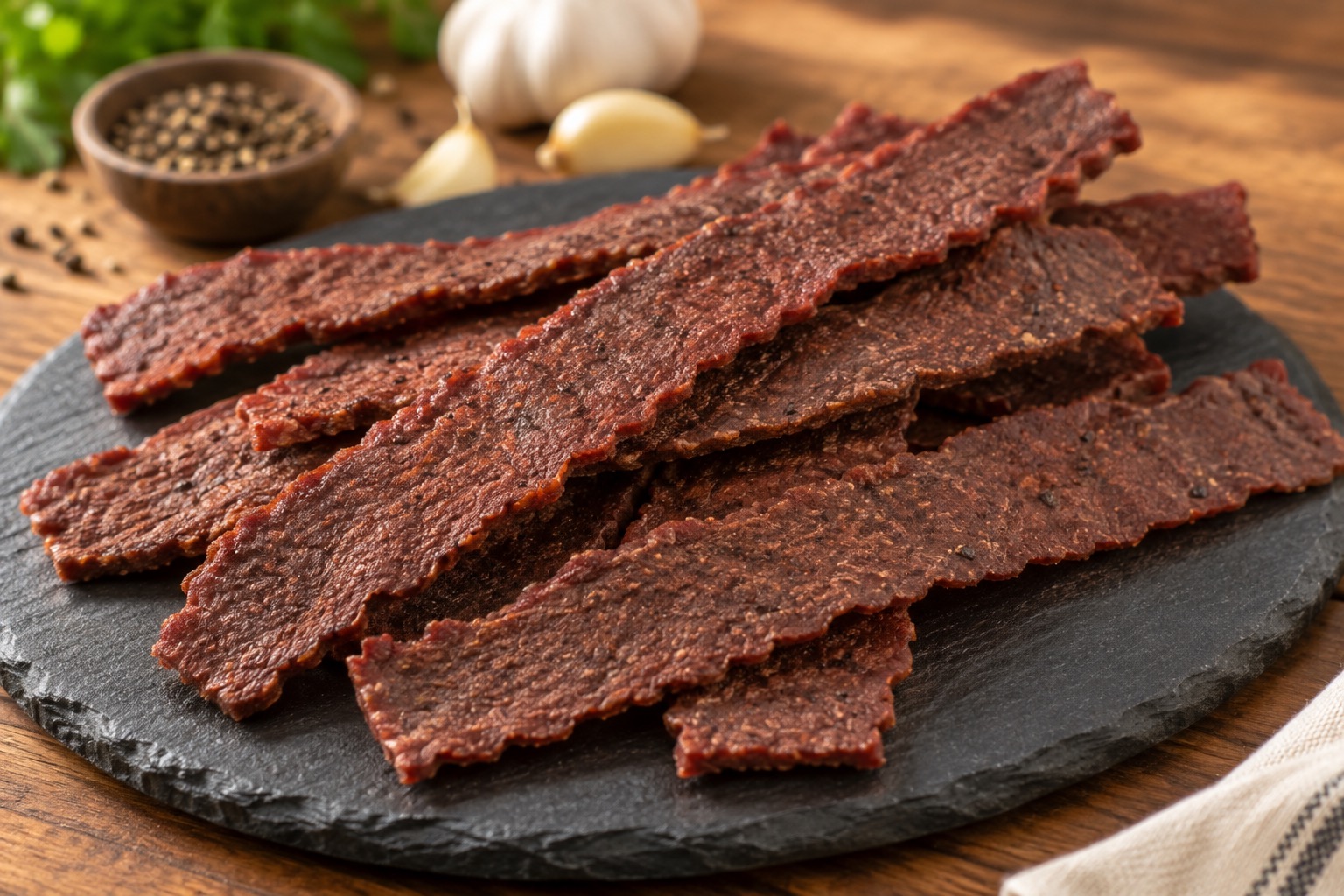
This ground beef jerky recipe starts with extra-lean beef and a savory mixture of soy sauce, Worcestershire sauce, garlic, onion, and black pepper. Brown sugar softens the salty edge, while optional liquid smoke and cayenne let you adjust the flavor. Form the seasoned meat into thin strips with a jerky gun or roll it out by hand.
Ground meat jerky has a finer, more uniform bite than jerky cut from steak. It still needs careful heating and drying: a brown surface, a firm texture, or a dehydrator setting does not by itself establish that the meat reached a safe internal temperature.
Jump to recipe · Step-by-step instructions
Choose lean ground beef and simple seasonings
Choose ground round or extra-lean ground beef, ideally 93–96% lean. The percentage refers to lean meat, not fat: 93% lean beef contains about 7% fat. Excess fat makes the finished jerky greasy and can develop stale flavors. An 80/20 hamburger blend is a poor fit for this recipe.
Keep the meat refrigerated at 40°F or below until you are ready to mix. Thaw frozen beef in the refrigerator. Ground beef has a short refrigerated raw-storage window, so include the overnight seasoning rest in the time since purchase or thawing rather than treating it as a fresh start.
Soy sauce and Worcestershire sauce supply much of the salt. Garlic powder and onion powder distribute more evenly through ground meat than large pieces of fresh onion or garlic. The optional liquid smoke adds a smoky flavor without using a smoker. It is flavoring, not a preservation treatment.
Ground beef jerky recipe
Batch size: 2 pounds of raw ground beef, about 8 snack portions after drying. The finished weight varies. Hands-on prep: about 30 minutes. Chilling: at least 2 hours or overnight. Drying: allow several hours, often about 4–8, plus heating and cooling; appliance performance and thickness determine the actual time.
Ingredients
- 2 pounds lean ground beef, preferably 93–96% lean
- ½ cup soy sauce
- ¼ cup Worcestershire sauce
- 2 tablespoons brown sugar
- 1 tablespoon liquid smoke, optional
- 1 teaspoon garlic powder
- 1 teaspoon onion powder
- ½ teaspoon ground black pepper
- ¼ teaspoon cayenne pepper, optional
Equipment: mixing bowl, measuring spoons and cups, jerky gun or rolling pin, parchment for shaping, oven-safe racks and rimmed baking sheets, a food thermometer suitable for thin meat, and a temperature-controlled dehydrator or suitable oven.
This recipe retains the original seasoning quantities. It is fairly salty and sweet, and the liquid smoke can be assertive. Use the optional ingredients according to your taste. If you make a half batch with 1 pound of meat, halve every seasoning quantity as well.
How to make ground beef jerky in a dehydrator
The illustrations show the main preparation stages. They are AI-generated recipe illustrations, not photographs documenting a tested batch. Follow the written temperature checks for heating.
1. Mix the beef and seasonings
Whisk the soy sauce, Worcestershire sauce, brown sugar, garlic powder, onion powder, black pepper, and optional liquid smoke and cayenne in a bowl. Add the cold ground beef and mix until the seasoning is evenly distributed and the mixture holds together. Do not taste the raw mixture.
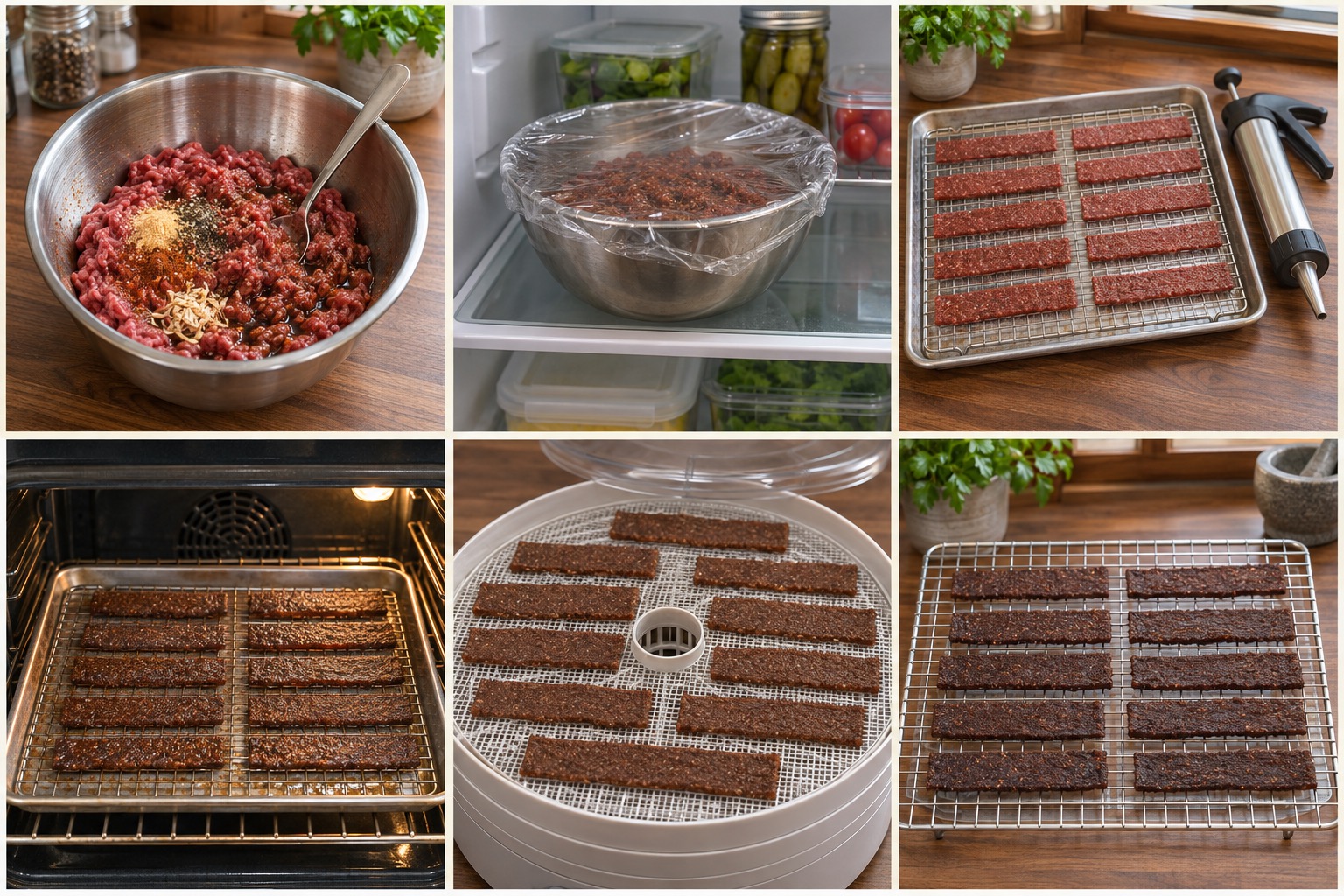
2. Cover and chill
Cover the bowl and refrigerate for at least 2 hours or overnight, keeping it at 40°F or below. This rest lets the seasoning distribute through the meat and makes the mixture easier to handle. Keep it cold while preparing trays and equipment.
3. Prepare the shaping equipment
For a jerky gun, pack the chilled mixture into the barrel, pressing out air pockets, and attach the flat-strip nozzle. Without a gun, place a portion between two sheets of parchment and roll to an even thickness no greater than ¼ inch.
4. Form strips and heat to 160°F
Form flat strips no thicker than ¼ inch on oven-safe racks over rimmed baking sheets, leaving gaps between them. Preheat the oven to 300°F and heat the formed strips until the centers reach 160°F, checking several pieces with a suitable thin-tip thermometer. Keep the probe away from the metal rack. Do not rely on a set number of minutes or the color of the beef.
5. Dry the heated strips, then finish heating
Using clean utensils, move the cooked strips to clean dehydrator trays. Dry at a steady 140°F with spaces between the strips. Check cooled samples periodically; they should be firm and dry throughout, with no soft, moist center. After drying, arrange on a baking sheet and heat for 10 minutes in an oven preheated to 275°F, as recommended by Kansas State Extension for ground-meat jerky.
6. Cool and store cold
Cool completely on a clean rack. Blot visible beads of fat with clean paper towels, divide into small airtight portions, and refrigerate. Freeze extra portions for longer storage. Never package the jerky while it is steaming or promise room-temperature shelf stability from this home recipe.
Jerky gun versus rolling pin
A jerky gun or jerky cannon makes repeated strips quickly. Use the flat nozzle for the thin strips described here; thick round snack sticks have different heating and drying needs. Air pockets inside the barrel can cause gaps and broken strips, so fill it in small portions.
With a rolling pin, work between parchment sheets so the mixture does not stick. Use a ruler to check thickness before cutting into strips with a knife or pizza cutter. Transfer the strips gently to the racks and remove the shaping paper before drying so air can reach the meat.
If the mixture feels loose, chill it again before shaping. Do not keep adding flour or breadcrumbs to fix it: those change the recipe. Keep a small first batch of strips uniform and compare their texture before filling every tray.
Heating and drying are separate steps
The USDA recommends heating meat to 160°F before dehydrating. Ground beef needs particular care because grinding can distribute contamination throughout the mixture. A dehydrator removes moisture; the number on its dial describes the appliance setting, not the temperature at the center of a strip.
The additional oven finish in this method follows Kansas State Extension's ground-meat jerky guidance. Use an oven thermometer to check the appliance. A thermometer designed for thick roasts may not measure a thin strip accurately; choose equipment whose sensing area fits the food.
Using a dehydrator
Preheat before loading the heated meat. Arrange strips in a single layer with room for circulating air. Follow the manufacturer’s tray-rotation instructions and check more than one tray. As the jerky dries, remove sample pieces briefly to cool before judging texture; warm strips can feel softer.
Using an oven
An oven must be able to hold a consistent low drying temperature after the initial heating stage. Use racks above rimmed pans, check the actual temperature, and follow the appliance’s dehydration instructions. If it cannot hold the low setting reliably, use a food dehydrator. Do not wedge the door open unless the manufacturer permits it.
Drying time varies with the thickness, amount of liquid, airflow, and tray load. Begin checking before the expected finish and continue until the centers are dry. The original four-hour estimate should not be treated as proof that every batch is ready.
Storing homemade ground beef jerky
Package cool jerky in small containers or resealable bags, label the date, and refrigerate. Freeze what you will not eat soon. Opening one small portion at a time helps keep the rest protected from handling and moisture.
Do not borrow the shelf life of an unopened commercial package. Home recipes and equipment do not automatically reproduce a manufacturer's validated process. Vacuum sealing changes the packaging; it does not repair inadequate heating or drying. Discard jerky with mold, off odors, or unexpected moisture rather than tasting it to check.
Flavor variations that keep this recipe recognizable
For mild jerky, omit the optional cayenne. For a more peppery bite, increase black pepper slightly in a future batch. For less smoky flavor, omit liquid smoke. Make one seasoning change at a time and keep a note so the next batch is easier to adjust.
Our hamburger jerky recipe uses molasses and apple cider vinegar, giving it a different flavor from this soy-Worcestershire version. The teriyaki beef jerky recipe uses sliced beef rather than ground meat.
Ground beef jerky questions
Can I use a smoker instead of a dehydrator?
A smoker can add smoke flavor, but this recipe's times are not smoker instructions. Use a validated ground meat jerky method suited to your appliance, measure internal temperature, and account for outdoor temperature and airflow. Smoking until the outside looks brown is not a reliable doneness check.
Is hamburger jerky the same as whole muscle jerky?
Hamburger jerky is another name for ground meat jerky. Whole muscle jerky starts with a sliced cut of beef such as eye of round; the direction of the grain affects its chew. Ground jerky is mixed and formed, so the key controls are even seasoning, consistent strip thickness, and keeping the mixture together.
Can I make the seasoning gluten-free?
Check the labels on soy sauce, Worcestershire sauce, and liquid smoke. Do not assume all brands share the same ingredients. A substitution changes the saltiness and flavor, so record the brand and amount when adjusting your homemade beef jerky recipe.
Should I add salt to the marinade?
The soy sauce and Worcestershire already contribute salt; extra table salt is not part of this recipe. Unlike sliced beef sitting in a marinade, ground beef is mixed directly with its seasonings, so most of that seasoning stays in the meat. For the best results, measure rather than pouring by eye.
Why is my ground beef jerky falling apart?
Uneven mixing, warm loose meat, air pockets, or very thin edges can make strips fragile. Mix evenly, chill before shaping, and keep the thickness consistent. Use a wide spatula to transfer fragile strips. Finished ground jerky does not have the long muscle fibers of sliced jerky.
Why is the jerky greasy?
Start with leaner meat next time. Blotting visible fat helps the surface, but it does not remove all fat mixed through the beef. Avoid treating a fatty burger blend as equivalent to extra-lean ground round.
Can I add curing salt?
This recipe contains no curing salt or Prague powder. Do not add an improvised quantity: curing products require their own exact instructions. Use a validated cured-jerky recipe if you want that method, and do not substitute ordinary table salt for a curing product.
Can I use ground turkey, venison, or pork?
This is a beef recipe. Ground poultry has a different minimum heating temperature, and wild game introduces additional handling considerations. Choose instructions written for that meat rather than assuming a direct swap has the same preparation requirements.
Is ground beef jerky healthier than store-bought jerky?
That depends on the ingredients and portion. Homemade jerky gives you control over seasoning, but this recipe still contains salty sauces and added sugar. An exact calorie or sodium figure requires a reliable calculation for the finished yield; the former fixed calorie estimate has been removed.
Recipe update: Original ingredient quantities are preserved. This revision corrects the lean/fat wording, adds heating checks, removes contradictory shelf-life claims, and makes the chilling and drying time clearer.