
How Long Does Deer Meat Last in the Freezer?
We may earn commission for items you purchase. As an Amazon Associate we earn from qualifying purchases.
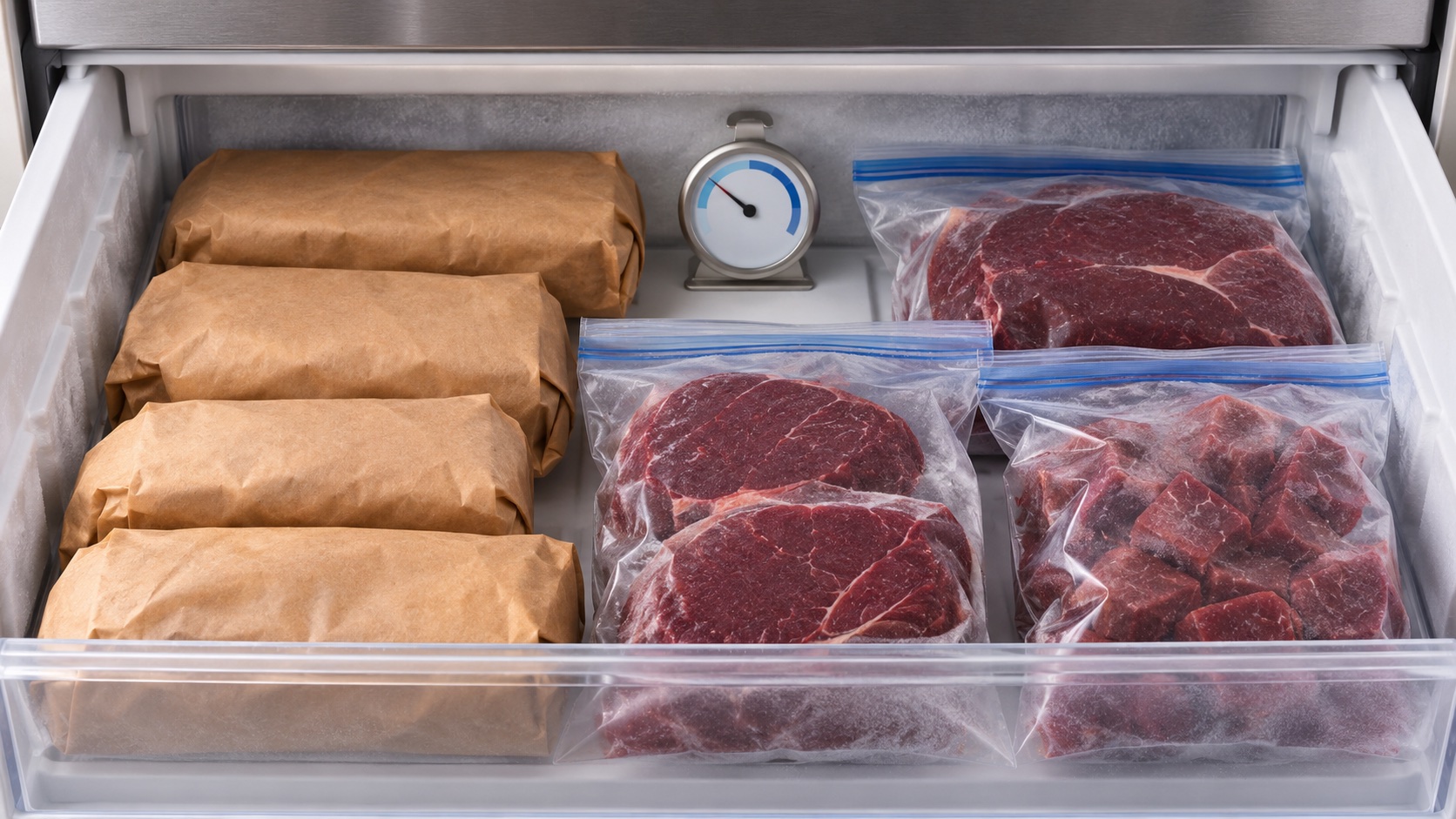
Properly handled venison kept continuously frozen at 0°F (−18°C) or below can remain safe indefinitely, but its flavor and texture decline over time. For best quality, Utah State University Extension suggests up to one year for well-packaged venison steaks, roasts and stew meat, and six to nine months for ground venison. These are quality guidelines, not proof that improperly handled meat is safe.
Hero image: an illustration of packaged meat in a freezer.
Venison freezer storage times
| Venison | Suggested freezer time for quality |
|---|---|
| Well-packaged steaks, roasts, chops or stew meat | Up to 1 year |
| Ground venison | 6–9 months |
| Cooked meat leftovers | 2–6 months as a general cooked-meat guideline |
The raw-venison estimates come from Utah State University Extension; the cooked-meat range comes from FoodSafety.gov's storage chart. Both assume proper preparation and a freezer at 0°F or below. Penn State gives a general nine-to-12-month guideline for properly wrapped venison; estimates vary because packaging and quality differ.
The freezer clock concerns quality. Freezing does not make spoiled, contaminated or previously mishandled venison safe. Use a freezer thermometer rather than relying on its dial.
How to package deer meat
Keep clean, properly chilled venison cold while portioning it. Package meal-sized portions in freezer wrap, freezer paper or freezer bags; press out excess air, seal securely and label the cut and date. Vacuum sealing can reduce air exposure, but it does not correct unsafe handling or replace freezing.
Arrange new packages so cold air can circulate while they freeze; once solid, stack them. Follow Penn State Extension's venison-freezing guidance for wrapping and handling.
Freezer burn, spoilage and power outages
Dry, discolored freezer-burned patches are mainly a quality issue and may affect taste and texture. An off odor, sliminess or other signs of spoilage are reasons to discard meat, but dangerous bacteria cannot always be seen or smelled. Never taste meat to decide whether it is safe.
If power fails, keep the freezer closed. FoodSafety.gov says meat that still contains ice crystals or is at 40°F (4°C) or below may be cooked or refrozen; quality can decline. Discard perishable meat held above 40°F for two hours or more. If its temperature history is unknown and safety is in doubt, discard it. Consult the power-outage chart for the circumstances.
How to thaw venison safely
Thaw in the refrigerator at 40°F or below, in a container that catches drips. Never thaw on the counter. For cold-water thawing, seal the meat in a leakproof package and change the cold water every 30 minutes. Microwave thawing is another option. Cook immediately after either cold-water or microwave thawing.
USDA says food thawed in the refrigerator can be refrozen without cooking if it was kept cold, though quality may suffer. Meat thawed by cold water or microwave should be cooked before refreezing. USDA provides more details on safe thawing methods.
Field handling, cooking and CWD
Safe storage starts before freezing: field dress promptly, keep equipment clean, cool the carcass and maintain cold temperatures during transport and processing. Penn State recommends cooking venison to a minimum internal temperature of 160°F, measured with a food thermometer. Reheat leftovers to 165°F.
In areas with chronic wasting disease (CWD), follow local testing and handling advice. The CDC recommends considering testing deer or elk from areas with CWD and says not to eat meat from an animal that tests positive. Freezing or ordinary cooking should not be relied on to eliminate CWD risk.
Common questions
Can I tell if venison is safe by smell?
No. Discard meat with signs of spoilage, but a normal smell does not prove that it is safe. Handling and temperature history matter.
Does vacuum sealing make venison safe longer?
It may protect quality by limiting air exposure. It does not make unsafe meat safe, and no single guaranteed shelf life applies to every package.
How long can fresh venison stay refrigerated?
USDA lists one to two days for ground game and three to five days for game meat at refrigerator temperatures before cooking. Prompt field cooling and handling are essential; when in doubt, discard it.
How long do cooked leftovers keep in the refrigerator?
Properly cooled cooked meat leftovers generally keep three to four days at 40°F or below. Refrigerate promptly.
Is venison unsafe after a year in the freezer?
Not solely because of the date: continuous freezing at 0°F or below maintains safety, while quality declines. This assumes it was safe before freezing and remained properly frozen.
What is the safest way to thaw it?
Thaw it in the refrigerator in a container that catches drips. Cook immediately after cold-water or microwave thawing.