
What Is a Jake Turkey? Jake vs. Tom Identification
We may earn commission for items you purchase. As an Amazon Associate we earn from qualifying purchases.
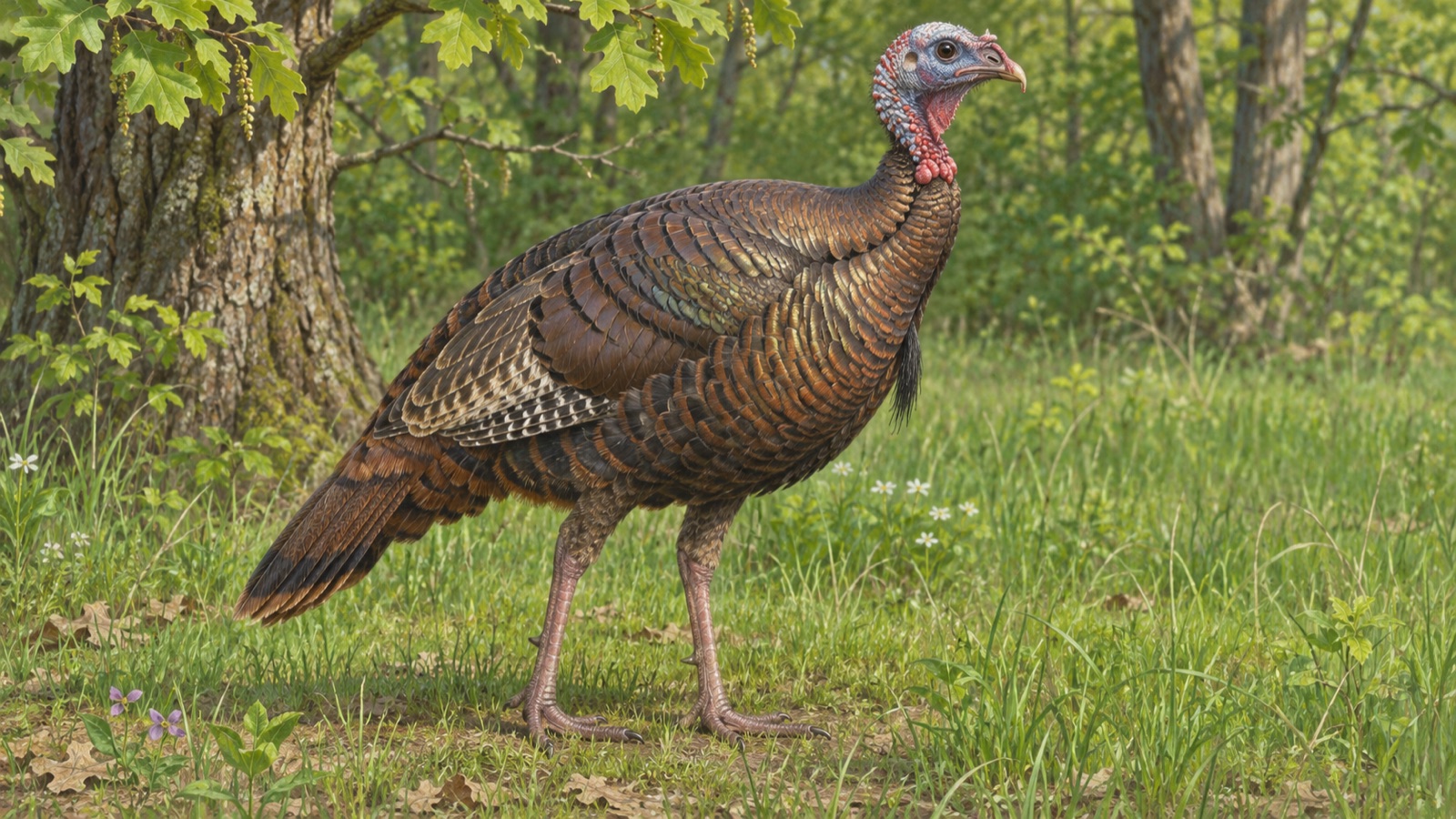
A jake turkey is a juvenile male wild turkey, usually the young male you see during its first spring after hatching. An adult male is commonly called a tom or gobbler. “Jake” describes the bird's age and sex; it is not a turkey breed or subspecies.
The most useful field clues are a short beard, an uneven tail fan with longer feathers in the center, and immature spurs. Use several features together. A distant bird, a partly hidden beard or a closed tail can leave too little information for a confident identification.
Jake, tom, hen and poult: what the names mean
| Name | Meaning | What it tells you |
|---|---|---|
| Jake | Juvenile male wild turkey | Age class and sex, not a subspecies |
| Tom | Adult male wild turkey | A mature male; also commonly called a gobbler |
| Hen | Female turkey | Sex; a young female may be called a jenny |
| Poult | Young turkey chick | A very young bird of either sex |
These names answer a different question from a subspecies name such as Eastern or Osceola. Calling a bird a jake does not identify its geographic population. It also does not mean that it is a domestic bird raised for meat.
How old is a jake turkey?
During spring turkey season, a jake is generally a male hatched the previous year. “About a year old” is a useful shorthand, but the transition to an adult is tied to development and molt rather than a birthday that an observer can determine in the field.
The National Wild Turkey Federation's explanation of the jake transition places acquisition of adult plumage at roughly 17–18 months, during the bird's second fall. By the following spring, it is the familiar two-year-old gobbler. A mature male two years old or older is therefore not the definition of a jake.
Keep the season in mind when comparing photos. A developing summer bird and a first-spring jake do not present exactly the same identification problem. Avoid assigning a precise age from one distant photograph simply because a bird looks smaller than its flockmates.
Jake vs. tom: compare the tail fan first
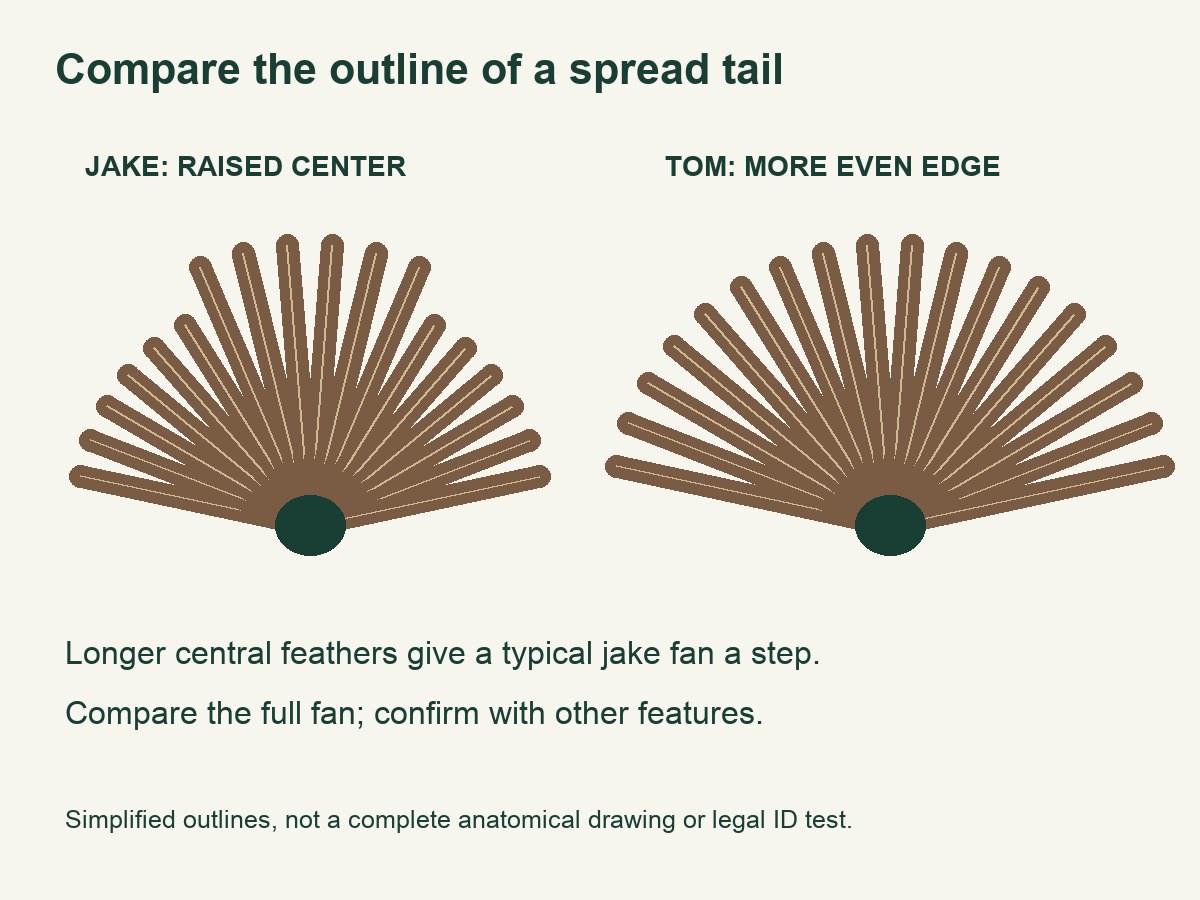
When a jake fans its tail, the central feathers typically project above the shorter feathers beside them. This produces a raised middle section or step. A typical adult tom's spread fan has a smoother, more even outer edge. MassWildlife's identification guidance illustrates this distinction.
Look at the outline of the whole fan, not just one feather visible through brush. A closed tail does not show that outline, and an angled view can make the shape harder to judge. Wait for the bird to turn or display rather than filling in what you cannot see.
| Feature | Typical jake | Typical adult tom |
|---|---|---|
| Spread tail | Longer central feathers create a stepped outline | More even outline across the fan |
| Beard | Shorter and sometimes difficult to see | Usually longer and more prominent |
| Spurs | Small, blunt or button-like | More developed |
| Interpretation | Look for agreement among features | Do not rely on size or beard alone |
Do jakes have beards and spurs?
Yes. A jake can have a beard, but it is usually shorter than an adult male's. The beard is the tuft projecting from the chest, not the fleshy structure above the beak. Some young males show only a small visible tuft.
Tennessee's wild turkey identification tutorial describes jake beards as less than six inches and notes that some hens also have beards. That makes “I can see a beard” an incomplete answer to both the sex and age questions.
Spurs grow on the backs of the legs. Young males have less developed spurs, while adults generally have longer ones. They may be hidden by grass or too small to judge at normal viewing distances. Do not approach or disturb a bird just to obtain that detail; use binoculars and accept an uncertain identification when needed.
For a bird already lawfully harvested, an agency aging guide can also help with wing feathers. Connecticut's reporting guide compares juvenile outer wing feathers with pointed, unbarred tips against the rounder, barred-to-the-tip adult feathers. That close inspection is different from a practical pre-shot field check.
Tell a jake from a hen using several clues
Male wild turkeys generally look darker and more iridescent, with less feathering on the head and more conspicuous red, blue or white bare skin. Hens tend to look browner, with a more blue-gray head and feathering extending farther up the head and neck. Lighting and viewing angle can make color comparisons difficult.
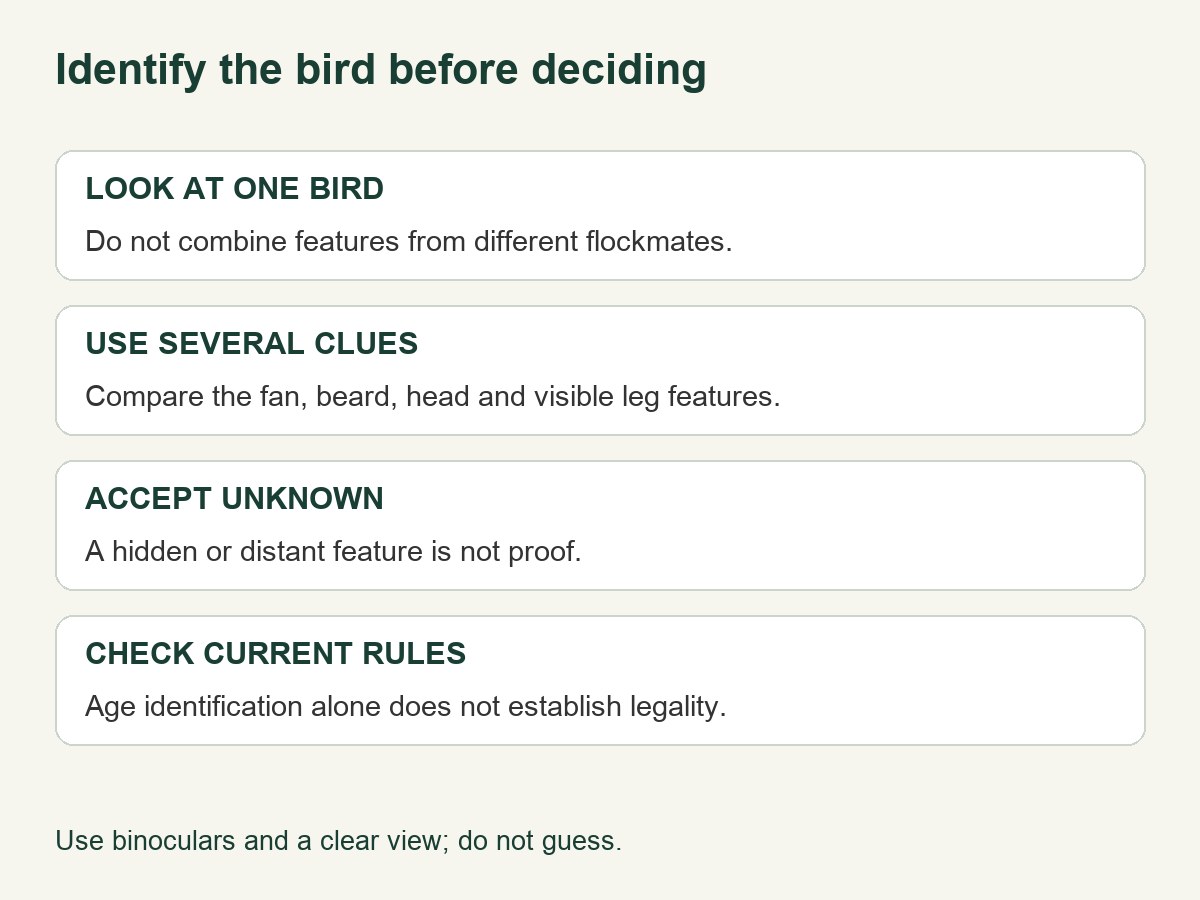
Combine the head, body, beard and tail observations rather than treating one feature as decisive. Tennessee's tutorial includes an obstructed bird that it leaves unidentified because the photograph does not show enough. “Unknown” is a useful observation, especially when the alternative is a guess.
If you are watching a group, follow one bird at a time. It is easy to notice the beard on one turkey and the fan on another, then unconsciously combine them. Make a short note or take a clear photograph from a respectful distance when you want to compare observations later.
Do jakes gobble, strut and travel in groups?
Jakes can gobble and strut. A gobble does not, by itself, prove that the caller is an adult tom. The NWTF's Life of a Longbeard describes variation among jakes: some gobble, some do not, and they often associate in groups.
You may hear a particularly developed young male called a “super jake.” This is an informal description, not a separate species or a substitute for inspecting physical features. Do not assume that a loud call, assertive behavior or a large-looking body settles the age question.
Behavior is useful context for watching turkeys, but it should not override a clear view of the bird. Nor does a silent turkey necessarily mean a hen. If the tail stays closed and vegetation hides the chest, the observation may remain unresolved.
Is it legal to hunt a jake turkey?
Check the current rules for the state, season, hunting area and hunter's eligibility. There is no single nationwide answer that makes every jake a legal bird. Regulations may distinguish adult gobblers, jakes, bearded birds and youth opportunities, and public areas may add their own restrictions.
For example, the Arkansas Game and Fish Commission's turkey regulations page links its current legal-turkey definition and lists youth and area-specific provisions. Use the current agency guide for your destination rather than carrying a rule from another state into the field.
Before hunting, confirm the legal bird definition, season dates, bag limit, required permissions and reporting requirements. A biological identification and a legal harvest decision are related but separate checks. If you cannot identify the bird confidently, do not shoot.
Can you eat a lawfully harvested jake?
A jake can be prepared as wild turkey. Calling it a jake does not create a special nutritional category or guarantee a particular flavor or tenderness. Handling, the cut and the cooking method matter; this article does not claim a tested nutritional profile for jake meat.
Use safe game handling and a food thermometer. USDA poultry guidance calls for an internal temperature of at least 165°F. For a whole bird, check the thickest breast area and the inner thigh and wing. Our smoked wild turkey leg recipe is a related cooking article.
Jake turkey questions
Is a jake a male or a female?
A jake is a juvenile male. A female is a hen; a young female may be called a jenny.
Does every short-bearded turkey have to be a jake?
No. Beard appearance is one clue, not a complete identification. Look at the bird's other features, and remember that some hens have beards.
Is a jake the same thing as a gobbler?
“Gobbler” is commonly used for a male turkey, often an adult tom. “Jake” specifically tells you that the male is immature. Use the more precise term when age matters.
Why is it called a jake?
The wildlife references used here explain what the term means, not a verified origin for the name. The earlier claim that a call sounds like the name “Jake” was unsupported and has been removed.