
Food Plot ATV Equipment: Discs, Spreaders and Cultipackers
We may earn commission for items you purchase. As an Amazon Associate we earn from qualifying purchases.
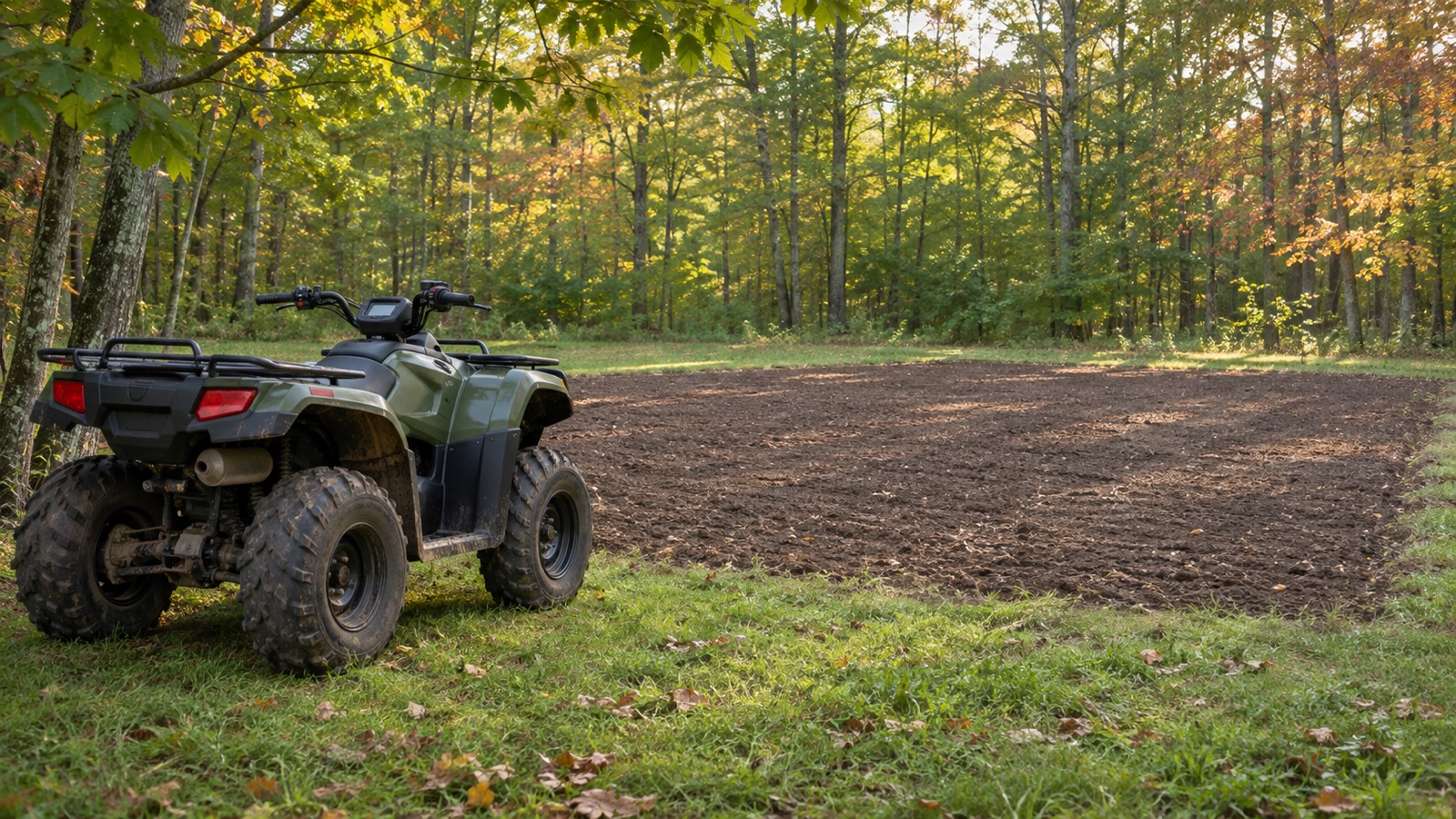
The best food plot ATV equipment is the equipment that handles your next planting task and fits your vehicle. For a small conventional plot, that may mean a disc for soil preparation, a calibrated spreader for seed, and a cultipacker for firming the seedbed. A rake is useful for loose surface material, but it is not a substitute for ground-working equipment.
Start with the plot's condition, your chosen crop and the ATV's manual. You do not necessarily need every attachment. An established plot that needs overseeding presents a different job from new ground covered in sod, roots and stones. Soil testing and a planting plan should come before buying an implement on the strength of its advertised acreage.
You can also browse ATV food plot equipment listings. Search results can change; verify each product's specifications and mounting requirements.
This guide compares five existing product destinations using Amazon product data checked November 4, 2026. All five had a new offer at that check; availability can change. These are specification-based comparisons, not claims of personal field testing. As an Amazon Associate, Sportsman Crew earns from qualifying purchases.
Which attachment does each job?
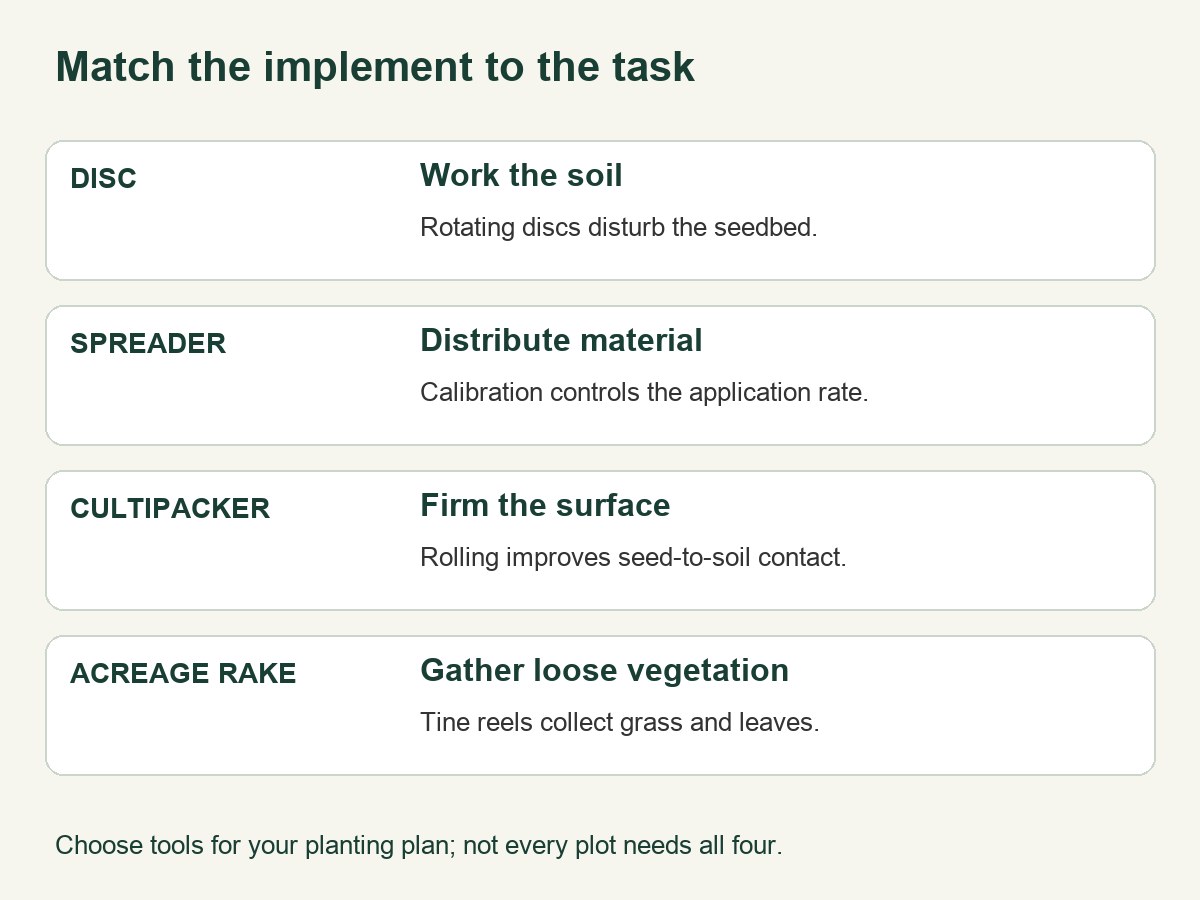
| Task | Equipment | What to check | Important limit |
|---|---|---|---|
| Work a seedbed | Disc plow or disc harrow | Receiver, lift requirements, soil condition and vehicle limits | Not a stump or boulder remover |
| Distribute seed | Broadcast spreader | Material compatibility, power, mounting and calibration | Does not control planting depth |
| Firm loose soil | Cultipacker | Compatible mounting system and crop needs | Does not replace tillage or weed management |
| Gather loose grass and leaves | Acreage rake | Hitch type, working width and access | Not a disc, cultivator or root-removal tool |
| Place seed through surface residue | Suitable no-till drill | Vehicle suitability, openers, seed metering and depth control | A broadcast spreader is not a drill |
For a conventional small-seed planting, a firm seedbed and seed-to-soil contact matter more than owning the widest attachment. Mississippi State University's Supplemental Wildlife Food Planting Manual recommends soil testing and describes cultipacking a prepared bed, then packing again after broadcasting small seeds. Crop requirements vary, so follow species-specific guidance for depth and rate.
Disc options for soil preparation
Battle Armor Big Buck 28-inch disc plow harrow

Product details
Battle Armor Big Buck 28-inch disc plow harrow
A new offer was available on November 4, 2026. Confirm the exact model, included components and current availability.
The Big Buck listing identifies a 28-inch cutting width and a 2-inch receiver mount. It describes disc blades, an integrated clean-out system and a transport-position lock. Although the earlier article placed it under a chisel-plow heading, this destination is a disc implement. A chisel plow uses shanks or chisels rather than a row of rotating discs.
Consider this narrower option where access and maneuvering space matter. Its advertised one-to-two-acre application is not a promise about how quickly your ATV can work that area. Soil hardness, vegetation, traction and repeated passes affect the job. Confirm the exact vehicle and hitch requirements before purchase; a listing's broad compatibility language does not override the ATV manufacturer's limits.
The seller specifically excludes lawn mowers. Do not treat a matching receiver opening as proof that another vehicle can safely operate it. Check clearance while turning, the transport position and all mounting hardware using the current manual. Inspect and clear obstacles before starting rather than trying to pull the discs through roots or large rocks.
Black Boar 66001 disc harrow
Product details
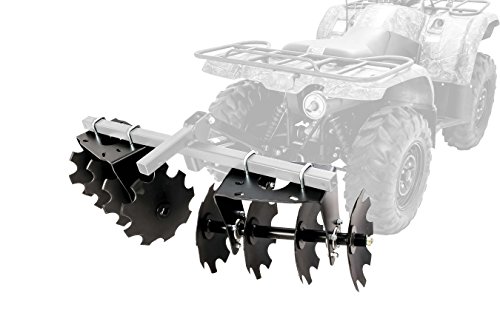
Black Boar 66001 disc harrow implement
A new offer was available on November 4, 2026. Confirm the exact model, included components and current availability.
The Black Boar 66001 has eight rotating discs. Current product details describe independently adjustable sides at 0, 15 or 30 degrees in either direction and a parallel-linkage design that maintains the implement angle as it lowers. Its listing specifies the Black Boar 66000 motorized implement lift, sold separately.
This makes the mounting system part of the buying decision. The harrow alone is not a complete ready-to-use attachment for an arbitrary hitch. Verify the lift, receiver requirements and vehicle compatibility together. Include the required lift and any approved installation components when comparing the complete setup with another disc.
Adjustment offers flexibility, but it does not establish a universal working depth or performance on every soil. Begin with the manufacturer's setup instructions and assess the result on your plot. Avoid assuming that a more aggressive angle always improves the seedbed. The goal is the preparation your crop requires, not the maximum disturbance the machine can produce.
Broadcast seed with the Guide Gear 80-pound spreader

Product details
Guide Gear 80-pound 12-volt broadcast spreader
A new offer was available on November 4, 2026. Confirm the exact model, included components and current availability.
The Guide Gear receiver-mount spreader has a listed 80-pound hopper capacity, a 12-volt motor, polyethylene hopper and included rain cover. The advertised broadcast width is approximately 12 feet. That width is a specification to investigate during calibration, not a guarantee that every material spreads uniformly over a 12-foot swath.
This is the seed-distribution option among the five linked products. Confirm its mounting hardware and electrical connection against your ATV or UTV. The filled hopper adds load behind the vehicle, so account for the attachment's weight plus its contents. You do not have to fill it to capacity, and capacity does not supersede vehicle or receiver ratings.
Use the manual's calibration procedure for the specific seed or approved material. Measure a test area, keep speed consistent, determine how much material was applied, and adjust before covering the whole plot. Seed size, flow characteristics, gate setting, overlap and travel speed affect the result. A hopper full of mixed seeds may not behave like a single uniform material.
Do not assume it handles powdered agricultural lime or every fertilizer simply because it broadcasts seed. Check the approved material list and cleaning instructions. Its rain cover also does not remove the need to keep materials in the condition required for reliable flow. A spreader distributes material; it does not create a seedbed or place seed at a controlled depth.
Firm the seedbed with the Black Boar cultipacker

Product details
Black Boar 66009 cultipacker implement
A new offer was available on November 4, 2026. Confirm the exact model, included components and current availability.
The Black Boar 66009 cultipacker is intended to break down clods and firm loose soil. Its listing specifies use with the Black Boar Implement Lift. Confirm the exact supported lift and vehicle installation before ordering; do not assume the implement includes the lift.
The earlier article incorrectly described adjustable tines and presented the cultipacker as a tillage tool. A cultipacker works by rolling and pressing the surface. It is not a chisel plow, a disc harrow, or a way to work around established seedlings with adjustable tines.
It is worth considering when your planting method calls for firming a prepared seedbed. For small seeds, a loose bed can make depth difficult to control. Packing and covering are different operations, however: do not assume rolling alone plants every crop at the correct depth. Use the seed supplier's directions or local extension guidance for the species you plan to grow.
A cultipacker also does not correct unsuitable moisture, nutrient deficiencies or a poor weed-management plan. Choose it to solve a defined seedbed problem rather than as a universal attachment for any soil or planting method.
Use the Yard Tuff acreage rake for surface cleanup

Product details
Yard Tuff 60-inch acreage rake
A new offer was available on November 4, 2026. Confirm the exact model, included components and current availability.
The Yard Tuff 60-inch acreage rake uses a pin-style hitch. Its current features list six 20-inch tine reels, 12-inch pneumatic tires and reel arms that can be raised individually to form windrows. The five-foot working path suits gathering loose leaves or grass and dethatching appropriate areas.
This is a surface-material tool. It is not the same as a heavy landscape rake, and its listing does not justify using it to break new soil, repair drainage or clear boulders. The old article overstated those roles. Buy it if gathering loose vegetation is an actual part of your maintenance plan, not because every food plot needs a hay rake.
Check the pin hitch, vehicle limits and access route. A five-foot implement may need more clearance through gates and along trees than a narrower disc. Decide where gathered material will go before making windrows, and follow the manual's height and transport instructions.
Check the complete ATV setup before buying
Compatibility includes more than hitch diameter. Read the ATV or UTV manual and the implement manual together, checking towing and attachment limits, supported mounting arrangements, ground clearance and electrical requirements. Receiver-mounted loads and tow-behind loads are not interchangeable assumptions.
- Mounting: identify whether the attachment needs a receiver, pin hitch or proprietary lift.
- Total load: include the implement, lift, approved accessories and spreader contents.
- Transport: verify the specified raised or locked position and clearance along the route.
- Working area: measure gates and allow space to turn without striking the vehicle or nearby obstacles.
- Support: check the availability of manuals, replacement parts and help for the exact model.
Follow the manufacturer's operating limits for speed, slopes and ground conditions. Keep bystanders clear, stop the vehicle before adjustment, and do not reach into moving parts. Avoid improvised ballast or hitch changes that the manuals do not authorize. If the vehicle cannot handle the required work, a different machine or hired preparation may be the better route.
Plan the planting method before the equipment list
Map the area you intend to plant, inspect its current cover and obtain a soil test appropriate to your crop. A purchase list based only on acreage misses important differences between an established opening and an uncleared site. Identify which tasks you can do with existing equipment and which require help.
A conventional approach may involve vegetation management, soil preparation, distributing amendments or seed, and firming or covering according to the crop's requirements. That is a task sequence, not a prescription to use every implement on every plot. Avoid turning seed too deeply into the soil simply to justify another pass with the disc.
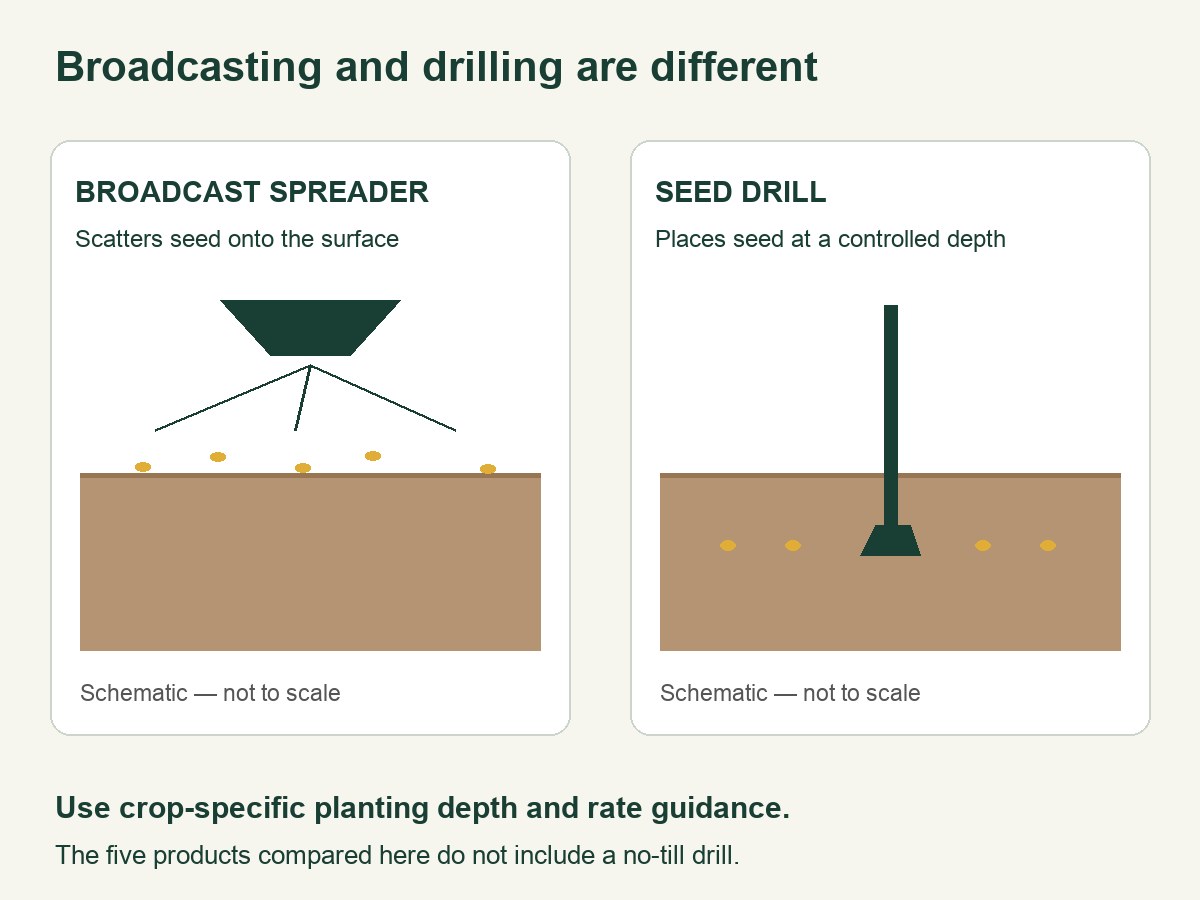
No-till is a separate planting approach. A suitable drill opens the soil, meters seed and controls placement without preparing the whole surface in the same way as conventional tillage. None of the five linked products is a no-till drill. Some crops and sites can also be overseeded, but broadcasting onto existing vegetation is not automatically a successful no-till system.
Use local guidance for the crop, soil and climate rather than assuming no-till eliminates fertilizer needs or guarantees a higher yield. For a small occasional project, compare borrowing or hiring suitable equipment with storing and maintaining attachments that may be used only briefly each season.
Food plot ATV equipment FAQs
What should I buy first for a small food plot?
Identify the missing task first. If you already have a suitable prepared bed, a compatible calibrated spreader may matter more than another disc. If you need ground preparation, inspect the site and vehicle limits before choosing a tillage attachment. A soil test and crop plan help prevent buying equipment that does not solve the actual problem.
Can an ATV make a food plot without a tractor?
It can handle some small-plot tasks with equipment approved for the vehicle and conditions. That does not mean every ATV can prepare new ground or pull every attachment. Tough vegetation, obstacles, terrain and soil may require different equipment or professional preparation. Judge the job and complete setup together.
Is a cultipacker the same as a disc harrow?
No. A disc harrow works soil with rotating discs; a cultipacker firms the surface by rolling. They can serve different stages of a planting plan. Neither replaces the need to follow the crop's seed-depth requirements.
Does a broadcast spreader work as a no-till drill?
No. A broadcast spreader throws seed onto the surface. A drill uses a seed-placement mechanism and depth control. Choose the planting method for your crop and site rather than treating those tools as interchangeable.
Do I need all five attachments?
No. The two disc products are alternatives for a similar task, and the acreage rake addresses a separate cleanup need. Choose the smallest complete setup that fits your vehicle and planting plan. Check required lifts and mounting parts before comparing individual attachments.