
Best Hunting and Fishing Times: Plan Around Local Conditions
We may earn commission for items you purchase. As an Amazon Associate we earn from qualifying purchases.
The best hunting and fishing times depend on your location, target species, season and conditions. Start with a legal, safe window and recent local observations. Then use daylight, water conditions and optional solunar tables to refine the plan. A calendar rating cannot tell you whether fish are present at your spot or whether a deer will cross your stand.
Looking for today's times? Choose your exact destination and date in the tools below. This guide explains how to interpret those results; it does not display a live forecast for your location.
Find today's local times
| What you need | Where to look | Check before using it |
|---|---|---|
| Sunrise, sunset and moon data | US Naval Observatory daily data | Date, coordinates, time zone and daylight-saving setting |
| Coastal high and low water | NOAA tide predictions | Station location and displayed time zone |
| Flood, ebb and slack current | NOAA current predictions | The appropriate current station, which may differ from your tide station |
| Optional major and minor periods | Solunar Forecast | Replace any default location; treat activity ratings as predictions |
Write down the destination, date and time zone alongside the times. A saved screenshot without those details is easy to reuse on the wrong day. When traveling, check the destination's local clock rather than assuming your phone, watch and downloaded calendar all agree.
The USNO service provides astronomical events, including sunrise, sunset and twilight, with a separate daylight-saving option. Those events do not establish hunting permission. Consult the current wildlife-agency rules and property restrictions for your species, season and location before choosing a hunting window.
Choose a window in the right order
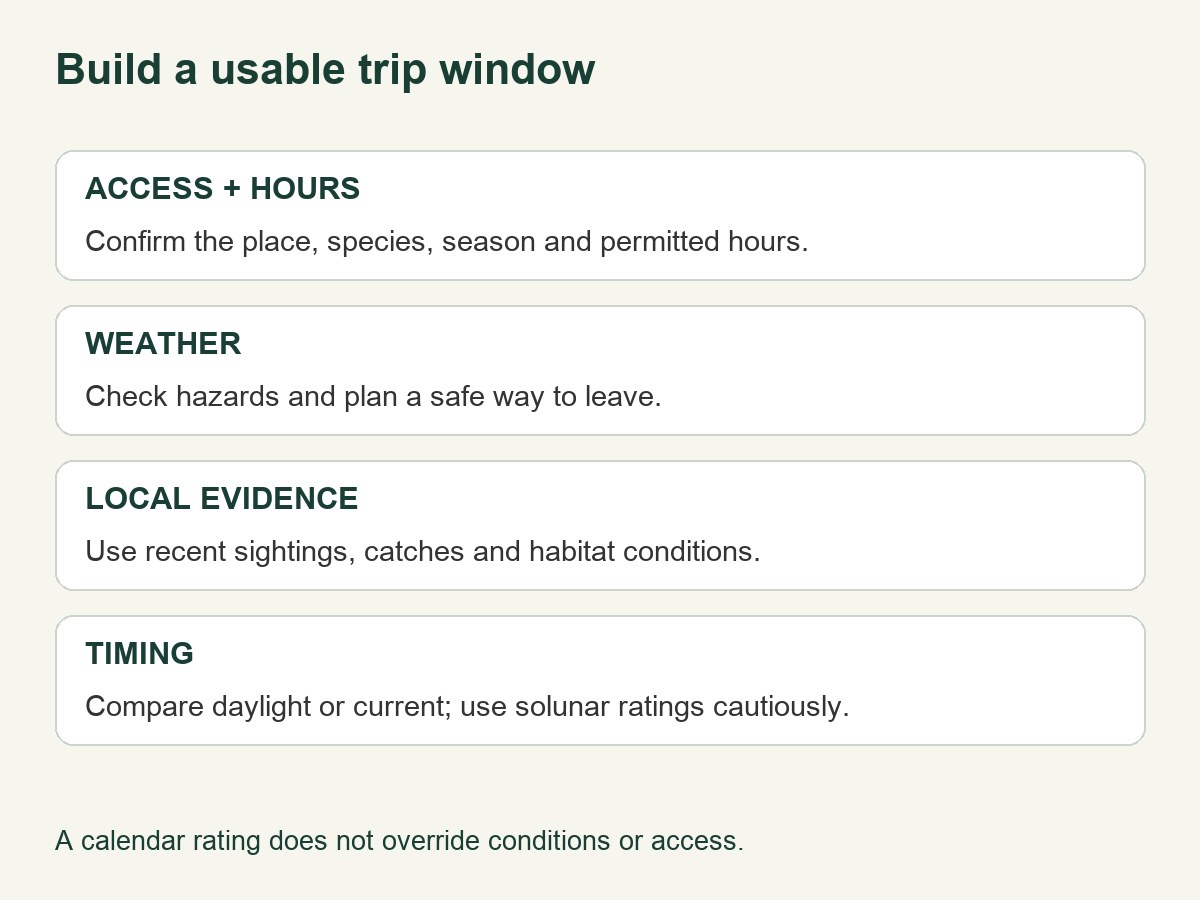
- Confirm access and permitted hours. Check the specific land or water, season, species and method. Leave enough time to enter and exit safely.
- Check the forecast. Consider wind, thunderstorms, visibility and any marine or river hazards that could end the trip.
- Choose the target. A whitetail hunt, a trout stream and a tidal inlet need different plans.
- Use local evidence. Review recent sightings, catch reports, habitat and your own log before selecting a location.
- Fit the timing to that location. Compare daylight or current predictions with the window you can actually use. Solunar periods are optional supporting information.
A useful plan names both a place and an action: arrive at an accessible bank before the chosen window, check water conditions, and move if the expected habitat is absent. “Fish on a four-star day” leaves most of the important decisions unresolved.
Keep an alternative in the plan. A sheltered bank, another legal access point or a shorter outing may suit the actual conditions better than the original destination. Do not let a favorable calendar rating override a deteriorating forecast.
What major and minor solunar periods mean
Solunar calendars combine sun and moon information to propose activity windows. Major periods commonly refer to roughly two-hour windows around the moon being overhead or underfoot; minor periods commonly refer to roughly one-hour windows around moonrise or moonset. These are conventions used by the forecasting method, not promises of feeding activity. Providers may implement their ratings differently.
Moon phase describes the illuminated portion of the moon. Moon position describes where it is relative to a location at a particular time. A full-moon date alone does not give you the day's major periods. See Mississippi State's explanation and test of solunar theory for the distinction.
If you use a calendar, compare its suggested period with your independent plan. Record both successful and unsuccessful outings, including time spent outside the suggested periods. Otherwise, a memorable catch during one window can make the forecast seem more reliable than your full experience supports.
Best hunting times for deer
Dawn and dusk are useful starting points for deer observation, but there is no universal clock time for every property. Plan around permitted hours, current sign and an approach that suits the site. For whitetails, consider the local breeding season rather than assuming rut dates from another region apply.
In a study of 48 GPS-collared bucks over two years in central Mississippi, researchers found no meaningful movement change when moon phase and major/minor windows were combined. They also found no meaningful extra activity from those windows at dawn and dusk compared with usual movement then. That is evidence about those deer, not a universal test of every animal or fish. Read the MSU results.
Use recent, relevant observations to decide between morning and evening. Note when animals used a particular route, where you can approach without disturbance, and whether conditions have changed since the observation. A trail-camera timestamp is most useful when its clock is correct and the location still has the same food, cover and access conditions.
For longer waits, plan clothing for the stationary part of the outing as well as the walk in. Our hunting layering guide explains how to separate those needs. Comfortable preparation helps you carry out a sensible schedule; it does not create a guaranteed movement window.
Best fishing times depend on the water
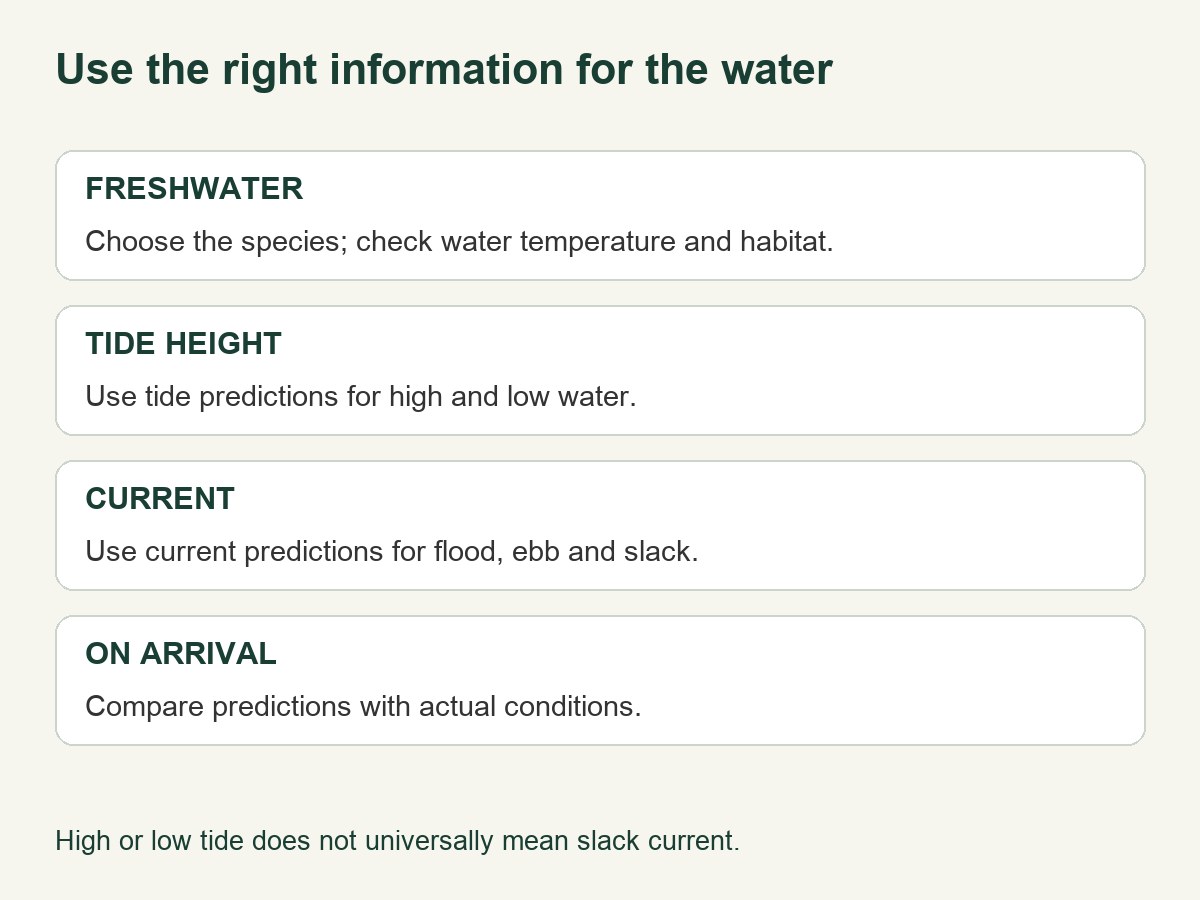
Freshwater: match conditions to the species
Choose a species and water body before searching for a best hour. Compare recent local reports, water temperature, depth, cover and available food. An air-temperature forecast is useful for planning your outing, but it is not a measurement of the water you will fish.
Florida's fish-temperature guidance lists different preferred feeding ranges for different freshwater species and explicitly notes substantial variation. It is a planning reference, not an on/off bite switch or a universal chart for every lake.
When reviewing a catch report, look for the date, species, depth and part of the water body. A report from the same lake can still describe a very different situation from your accessible shoreline. Ask a local fisheries office or tackle shop which conditions the report reflects, then record what you actually find.
Coastal water: separate tide height from current
Tide predictions describe water height; current predictions describe horizontal flow. NOAA warns that slack water does not universally occur at high or low tide. The relationship depends on the location, so consult the appropriate current prediction when flow is central to your plan. NOAA explains the difference here.
Use the relevant station and check its time setting. A chart for a nearby harbor is not automatically an accurate schedule for every inlet or channel. Compare predictions with conditions on arrival, and allow for safe access and return. Avoid turning “moving water” into a rule that stronger current is always better or safe to fish.
Keep a timing log that you can use
A simple notebook can make later planning more specific. Record the following after each trip, including the quiet ones:
- Date, location and actual start/end times.
- Target species and method.
- Weather and observed water or ground conditions.
- Depth, cover, current or route you actually used.
- Sightings, bites, catches and periods with no activity.
- Anything that changed your plan, such as access, other users or a forecast shift.
Compare similar outings rather than mixing every trip into one rule. Two hours at one bank and ten hours covering several locations are different amounts of opportunity. Record effort so that a larger catch total is not mistaken for a better hour.
For a hypothetical evening trip, your notes might identify a usable access point, the local sunset, the expected current window and a return deadline. Leave the catch column blank until the trip happens. This is a planning exercise, not a claim that we tested a particular forecast.
Earlier linked products: what they actually are
The earlier version mixed timing advice with products that do not predict wildlife activity. The existing links remain below with corrected identities. Amazon listing checks were made on November 4, 2026; availability can change. None of these items is presented as a verified hunting or fishing forecast tool.
On Time 46007 programming key
The listing identifies a digital programming key used to program the Ultra Hunt. It is not a stopwatch or a verified sun-and-moon activity calculator. Confirm compatibility with your existing equipment before ordering.

Product details
On Time 46007 Ultra Hunt programming key
A new offer was available on November 4, 2026. Confirm the exact model, included components and current availability.
RANDY SUN number 23 socks
This destination is the red, Small, mid-calf number 23 variant. The listing describes waterproof socks, but the checked variant was unavailable. Clothing choice does not establish a feeding window; we have no documented wear test to report.

Product details
RANDY SUN number 23 socks — Red, Small
Unavailable on November 4, 2026. Retained for reference; not a confirmed current purchase option.
Best Recipes of Alaska's Fishing Lodges
This is a recipe book. The earlier description incorrectly presented it as a current directory of lodges, facilities and optimal travel dates. Use current destination information when planning a trip.

Product details
Best Recipes of Alaska’s Fishing Lodges — book
A new offer was available on November 4, 2026. Confirm the exact model, included components and current availability.
Hunter's Tail FB1000 spinning reel
The linked reel is the silver FB1000 listing with a stated 5.2:1 ratio. It was unavailable at the check. Its earlier first-person review and numerical performance improvements were not supported by our own testing and are not retained as editorial findings.

Product details
Hunter’s Tail FB1000 reel — Silver
Unavailable on November 4, 2026. Retained for reference; not a confirmed current purchase option.
Speedy Pros Team Jesus cap
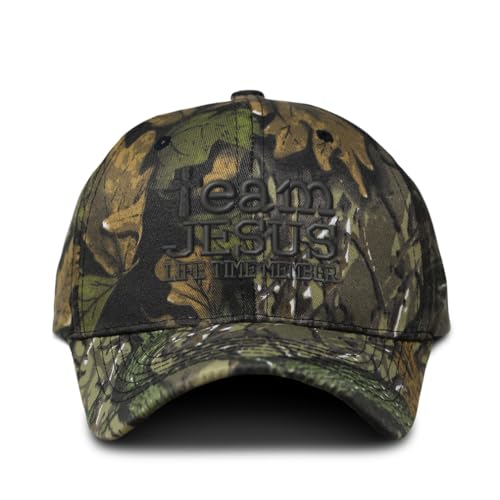
The checked destination is the Forest Tree Green “Team Jesus Life Time Member” design. It is an adjustable cap, not timing equipment. Camouflage does not make a wearer invisible, despite the earlier wording.
Product details
Speedy Pros Team Jesus cap — Forest Tree Green
A new offer was available on November 4, 2026. Confirm the exact model, included components and current availability.
Fish in a Tree
The destination is a downloadable book titled Fish in a Tree. It is not an aquarium, filtration system, fish feeder or fishing forecast app. The earlier article's equipment features and personal testing claims were incorrect.

Product details
Fish in a Tree — downloadable book
A new offer was available on November 4, 2026. Confirm the exact model, included components and current availability.
Earlier Deer Hunter listing
Amazon's API could not access this item. Its current identity, compatibility and availability are unverified, so it is not a current recommendation. The original destination remains for reference.
Product details
Earlier Deer Hunter listing — unverified
Amazon returned an item-not-accessible response. Current product identity, offer and image could not be verified.
ZKKEIIE Nintendo Switch fishing accessory
This is a game-controller accessory listed for Nintendo Switch and Switch OLED fishing games. It is not a field fishing rod. Check the exact console, controller and game requirements; a listing mentioning Switch does not establish compatibility with every later console.

Product details
ZKKEIIE fishing accessory for Nintendo Switch / OLED
A new offer was available on November 4, 2026. Confirm the exact model, included components and current availability.
The Girls' Guide to Hunting and Fishing
The checked destination is the downloadable book with this title. It is not a verified outdoor regulations guide or an algorithmic timing service. Do not rely on the earlier claims about maps, seasons or live updates.

Product details
The Girls’ Guide to Hunting and Fishing — downloadable book
A new offer was available on November 4, 2026. Confirm the exact model, included components and current availability.
Alone in the Wilderness
This listing is the film Alone in the Wilderness, not a device with GPS, a compass, an SOS button or real-time weather notifications. Those equipment descriptions in the earlier article were incorrect.

Product details
Alone in the Wilderness — film
A new offer was available on November 4, 2026. Confirm the exact model, included components and current availability.
Frequently asked questions
Can one calendar give the best time for every species?
No. A general calendar can supply shared astronomical data, but it does not establish the local presence, behavior or habitat needs of every species. Select the species and destination first.
Should I cancel because the solunar rating is poor?
A low rating alone is not a sound reason to discard a well-planned outing. Compare conditions, access and recent observations. Equally, a high rating is not a reason to continue into unsafe weather.
Is a major period the same as legal hunting time?
No. A forecast window may occur outside permitted hours. Check the current rules for the exact species, season, method and property; do not infer permission from a moon chart.
What if a forecast window overlaps thunderstorms?
Change the plan. The National Weather Service says there is no safe place outdoors when thunderstorms are nearby and advises going indoors when thunder is heard. Plan shelter and an exit before the outing.
Do I need to buy a special timing product?
You can begin with the public sun/moon and coastal prediction tools linked above, relevant local reports and a trip log. The practical work is choosing the correct location, date and conditions—not purchasing an unrelated item with “hunting” or “fishing” in its title.