
Do Deer Move in Fog? What We Know About Deer Activity
We may earn commission for items you purchase. As an Amazon Associate we earn from qualifying purchases.
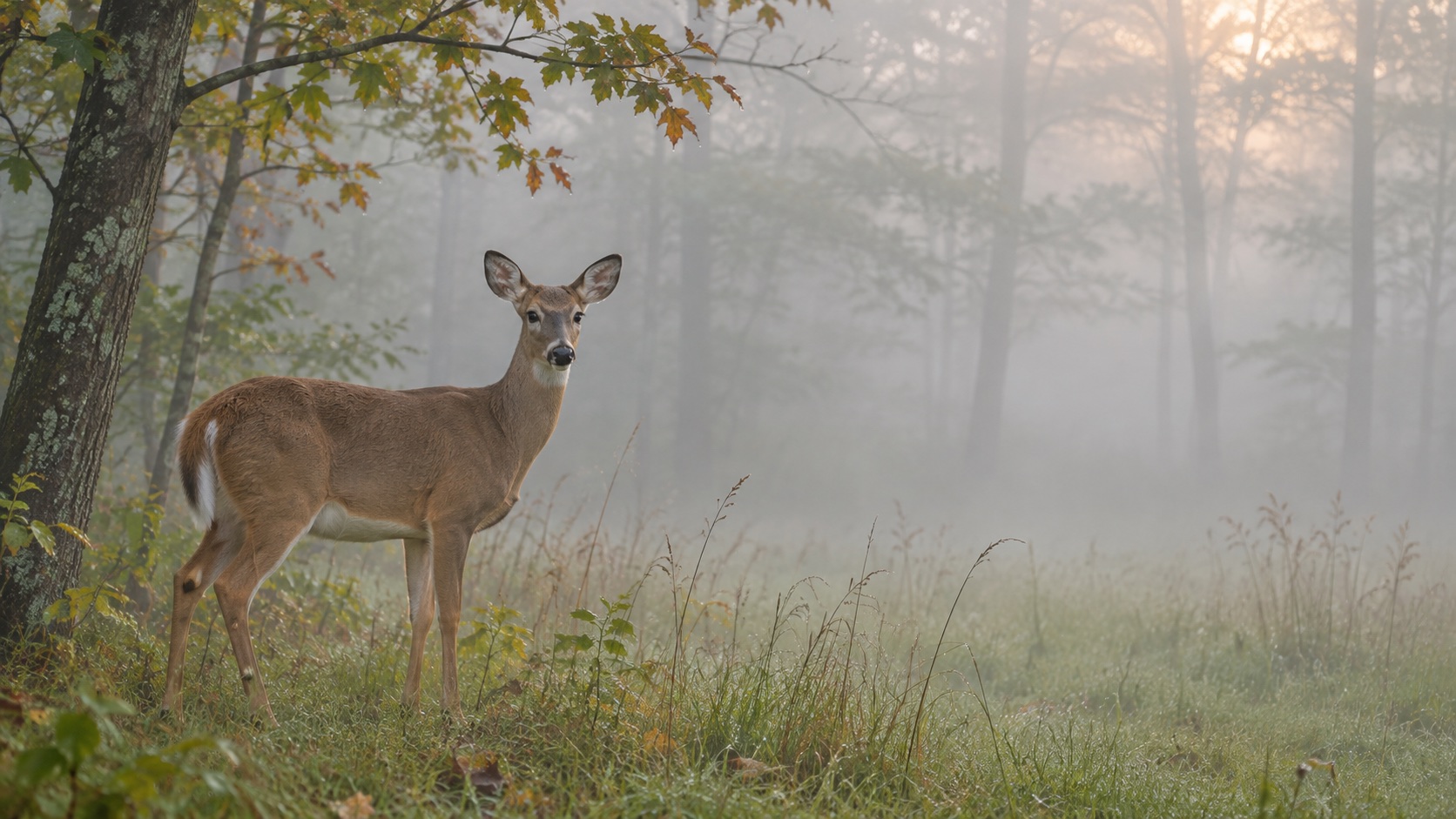
Yes, deer can move in fog. Fog does not prevent a deer from feeding or traveling, but there is not enough evidence to say that fog reliably makes deer more or less active. A deer that is harder to see may still be moving. Time of day, breeding season, habitat and the individual animal all matter.
Hero image: an illustration of a white-tailed deer in a misty woodland.
How does fog affect deer movement?
Fog reduces the distance at which people can see an animal. That is a visibility problem, not proof that deer have stopped moving. We did not find a study establishing that fog itself causes white-tailed deer to travel in circles, gather in groups, move less or become easier to approach.
Research does show why a simple weather rule is unreliable. A GPS-collar study of 32 white-tailed deer in Oklahoma found short-term weather influences on movement inconsistent across seasons. It did not isolate fog, so it cannot tell us exactly how deer respond to a foggy morning. The researchers observed most activity around dawn and dusk.
Mississippi wildlife biologists similarly report that time of day and breeding season generally have a stronger relationship with movement than individual weather measurements. Those findings reflect the animals and places studied, not a prediction for every foggy day.
What do deer do in fog?
Deer still need to feed, rest, and move between areas they use. Individual animals may be standing, browsing, bedded or traveling while fog is present. One sighting—or a morning without sightings—cannot establish whether a whole population changed its behavior.
Deer use several senses to gather information, including vision, hearing and smell. A Penn State field observation illustrates that deer can investigate scent left by another deer hours earlier. It does not show that a deer becomes blind in fog or predict how far it can smell.
Fog also varies: a thin patch over a meadow is different from dense fog throughout the woods. Local cover, light, temperature and recent disturbance can all change what an observer sees. Keep an observation log if you want to compare the same place across different conditions, without assuming a handful of sightings proves cause and effect.
Visibility and safety in fog
Reduced visibility can make other people, obstacles and road traffic difficult to see. If you cannot clearly see your surroundings, wait for conditions to improve. Follow local access rules and any required safety clothing, and let someone know your route and expected return time.
For the drive, slow down and leave more following distance. The National Park Service notes that fog reduces visibility for drivers and other road users.
Watching deer responsibly on a foggy day
Enjoy wildlife from a distance and avoid approaching or feeding deer. Stay on permitted routes and bring a light and suitable layers for changing conditions. A camera or binoculars can help you observe from a comfortable distance, but neither removes the need to account for limited visibility.
Expect observations to vary. On one foggy morning deer may appear along a familiar field edge; on another, fog may hide animals that are nearby. These possibilities are observations to consider, not evidence that fog produces a predictable route.
Frequently asked questions
Do deer move in thick fog?
They can. There is no reliable rule that thick fog stops deer movement; the fog may simply make deer difficult to spot.
Is fog better than clear weather for seeing deer?
There is no dependable fog advantage supported by the movement studies cited here. Reduced visibility can make observation harder even when animals are active.
Do deer move when fog lifts?
They may move before, during or after fog lifts. The timing of clearing alone does not reliably predict an individual deer’s activity.