
8×42 vs 10×42 Hunting Binoculars: Magnification, Fit and Product Options
We may earn commission for items you purchase. As an Amazon Associate we earn from qualifying purchases.
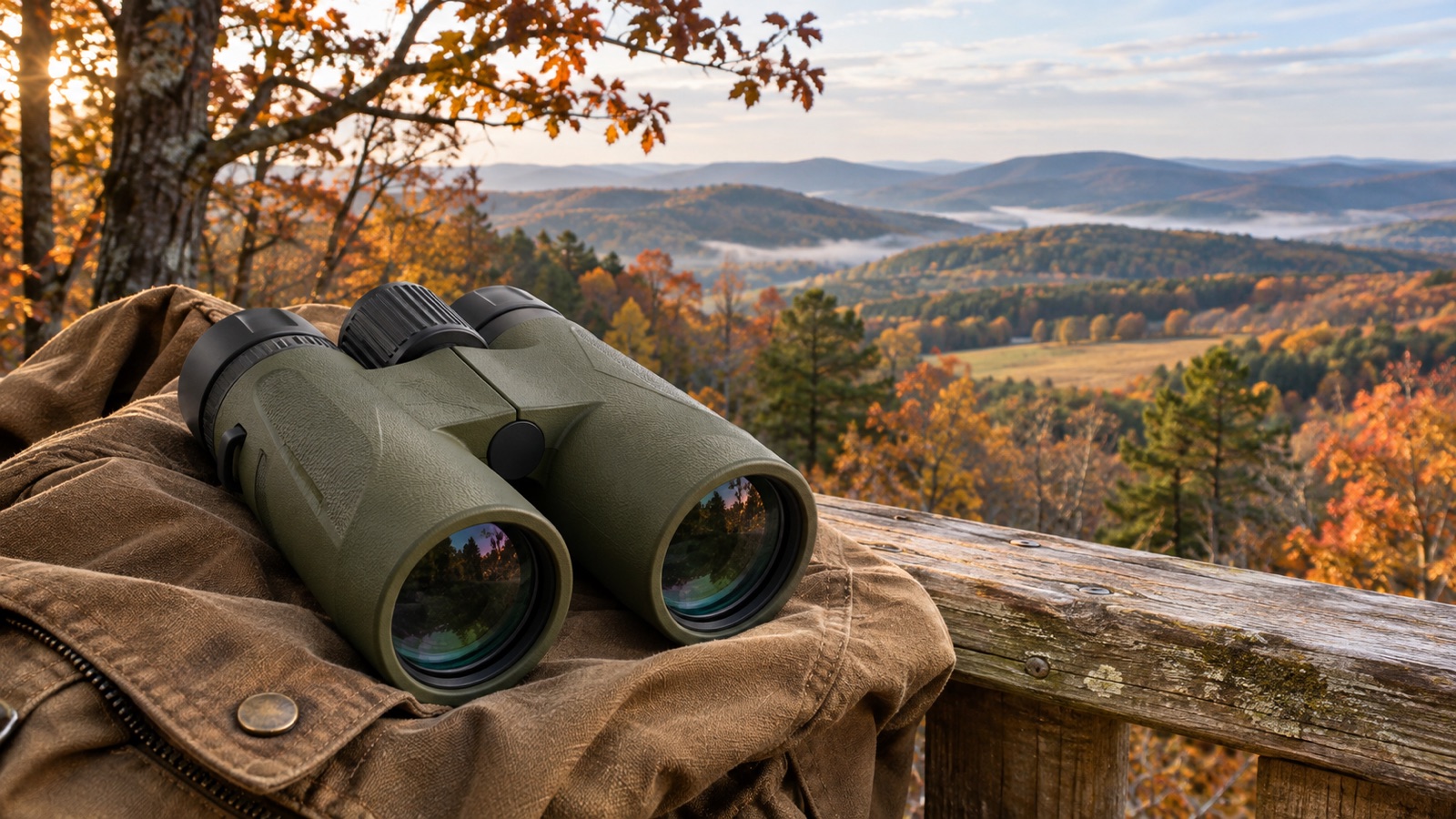
Choose 8×42 hunting binoculars when an easy-to-hold view and quick scanning matter most. Consider 10×42 when you regularly examine distant detail and can keep the binoculars steady. Both have 42 mm objective lenses; the difference is magnification, not a larger front lens. Neither size is automatically the better purchase.
This guide compares those trade-offs and uses the article’s original linked products as examples. Product details and availability were checked through Amazon’s Creators API on November 4, 2026. Six listings had in-stock offers, two were unavailable and two returned an availability-date status without a confirmed immediate delivery date. We have not conducted a side-by-side field test of these binoculars.
We may earn a commission from qualifying purchases through the affiliate links below.
8×42 versus 10×42 at a glance
| Consideration | 8×42 | 10×42 |
|---|---|---|
| Magnification | 8 times | 10 times; 25% larger apparent subject than 8× |
| Objective diameter | 42 mm | 42 mm |
| Calculated exit pupil | 5.25 mm | 4.2 mm |
| Handheld view | Usually easier to keep steady | Magnifies hand movement more |
| Field of view | Often wider within the same product family | Often narrower; compare actual specifications |
| A useful starting point | Frequent scanning and shorter woodland views | More distant observation across open ground |
The terrain suggestions are practical starting points, not distance limits. A good view depends on optical quality, light, atmosphere, eye fit and how steadily you hold the binoculars. An unfamiliar pair with more magnification may reveal less usable detail if you cannot stabilize it.
What changes when you move from 8× to 10×?
The first number describes magnification; the second gives the objective lens diameter in millimeters. Moving from 8× to 10× increases apparent linear subject size by a factor of 10 ÷ 8, or 1.25. It does not guarantee a 25% increase in resolved detail or extend an ethical shooting distance.
Higher magnification also makes hand movement more visible. A narrower real field of view can make locating an animal harder, although eyepiece design matters: compare the published field at the same distance instead of assuming every 8× model beats every 10×. Nikon’s binocular specification guide explains these magnification and viewing trade-offs.
Try both powers on the same stationary subject. First stand normally, then support your elbows. Notice whether you can repeatedly find the subject, hold the image still and focus without searching for the controls. That comparison is more useful than choosing the largest number on the box.
Exit pupil and low-light viewing
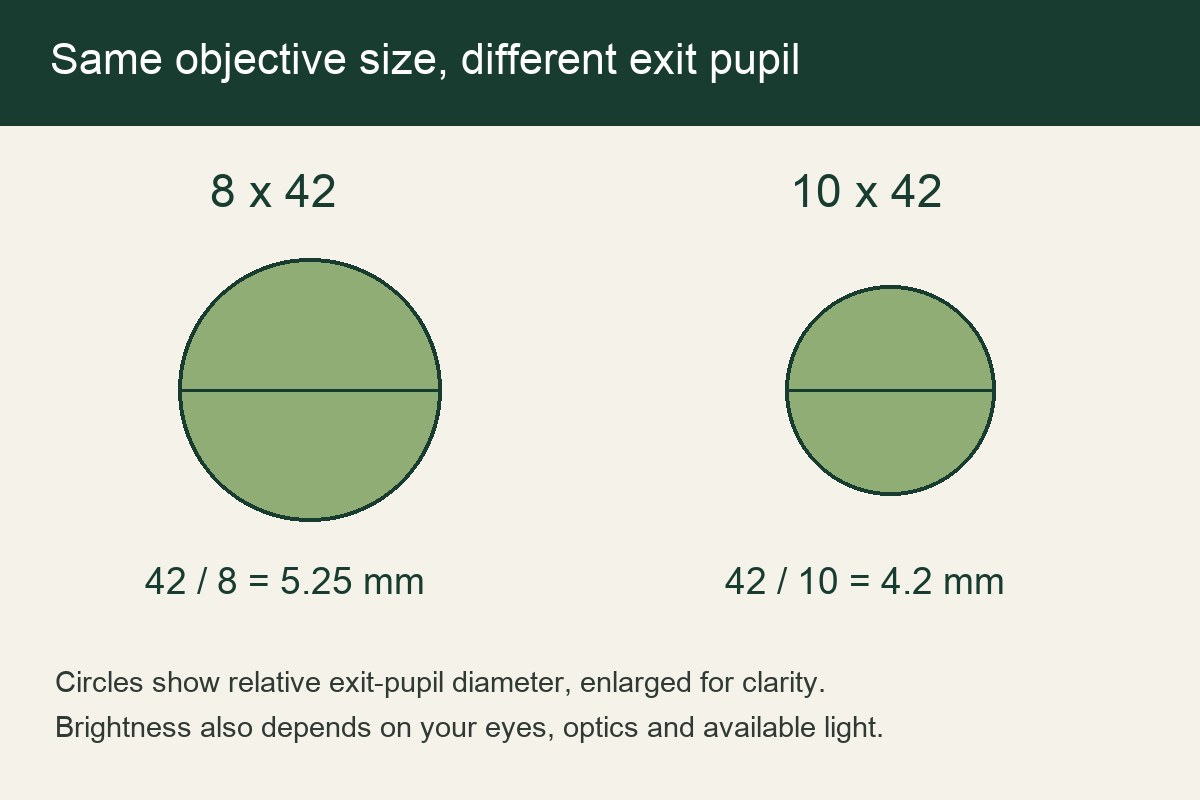
Divide objective diameter by magnification to calculate exit pupil: 42 ÷ 8 = 5.25 mm, while 42 ÷ 10 = 4.2 mm. The larger exit pupil can be helpful in dim conditions, but it is not a complete brightness score. Your eye’s pupil, optical transmission and viewing conditions also matter. Nikon’s exit-pupil explanation illustrates why the relationship changes with ambient light.
Do not interpret “low-light night vision” in a conventional binocular listing as electronic night vision or thermal imaging. These optical binoculars need available light. Nor does an “HD” label establish a measured resolution advantage over every competing model. Look for comparable specifications and, where possible, compare the actual view yourself.
Fit matters as much as magnification
Before judging sharpness, adjust the hinge to your eye spacing and follow the manufacturer’s instructions for focus and diopter setup. You should obtain one comfortable circular view. If the image repeatedly blacks out or you cannot see its edges, check eyecup position and eye relief rather than assuming the lenses are poor.
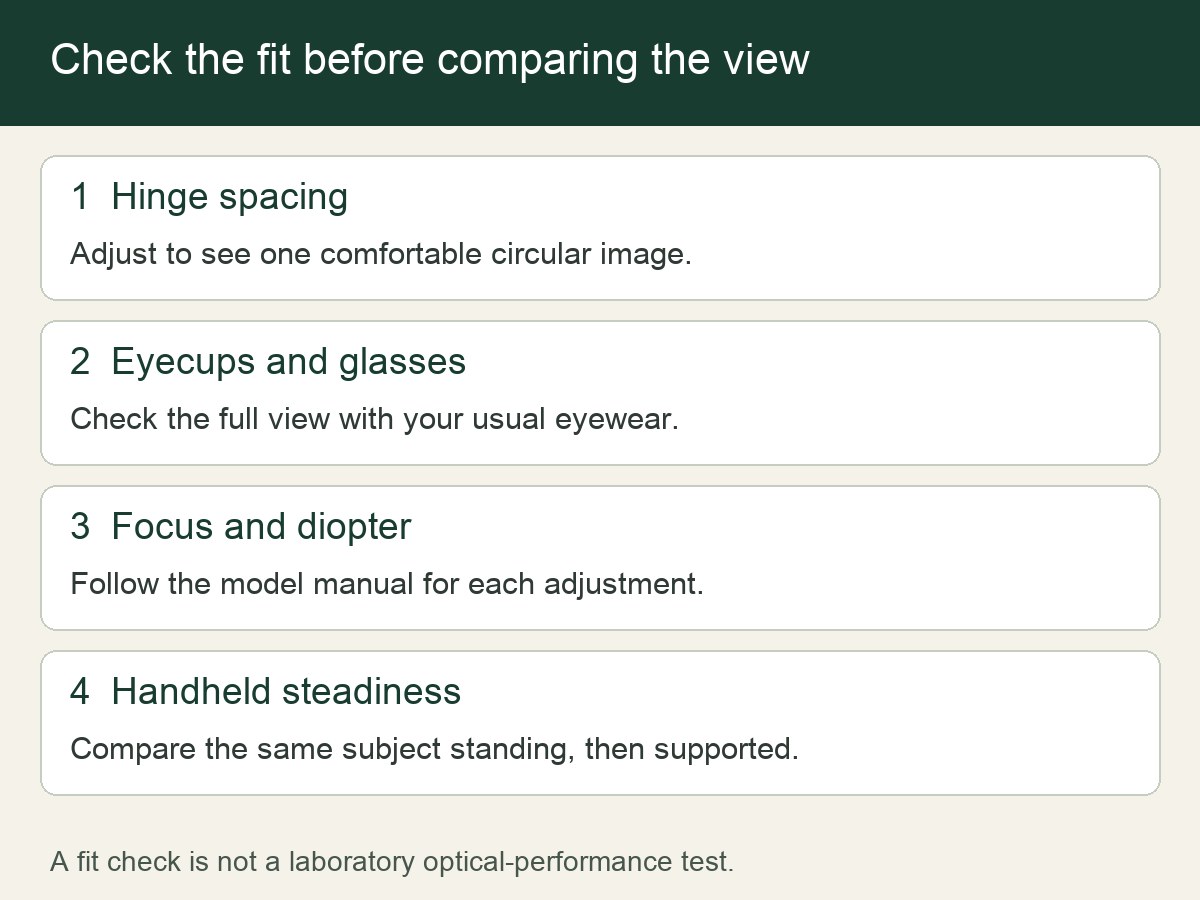
Eyeglass wearers should try the binoculars with the glasses they will actually use. A quoted eye-relief number helps compare models but cannot guarantee a full view for every face and frame. Check that the focus wheel remains accessible with gloves and that the hinge can reach your interpupillary distance.
A harness can make carrying more comfortable; it does not stabilize the view in the same way as a properly supported tripod. For longer observation sessions, confirm the binocular’s adapter connection and the support’s compatibility. Our hunting tripod guide distinguishes shooting supports from observation setups.
Available 8×42 and 10×42 examples
These examples had in-stock offers when checked. They illustrate different designs, not a laboratory ranking. Confirm the exact model and included accessories at the destination because listings and offers can change.
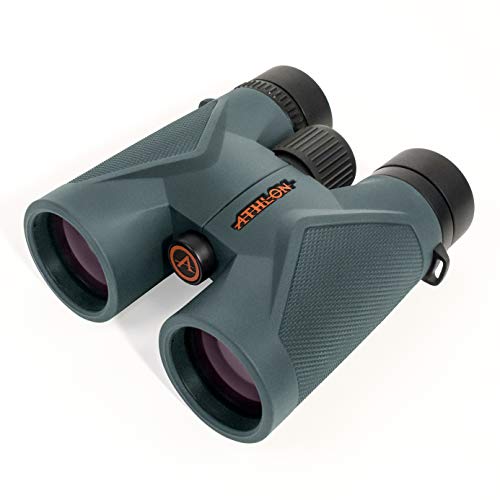
Athlon Midas UHD 8×42, Gray
Product details
An offer was available on November 4, 2026. Confirm the exact model, included components and current availability.
The linked Athlon is the gray Midas UHD 8×42, not an assumed substitute from the newer G2 range. The listing specifies ED glass, fully multi-coated lenses, dielectric prism coating and argon purging. It is the 8×42 example in this group and produces a calculated 5.25 mm exit pupil.
That combination makes it worth comparing when steady handheld scanning is your priority. Avoid treating the listing’s prism-reflectivity claim as total light transmission through the entire binocular. The manufacturer’s Midas UHD page describes this model’s construction; confirm the exact generation before borrowing dimensions or accessories from another Midas listing.
Vortex Crossfire HD 10×42

Product details
An offer was available on November 4, 2026. Confirm the exact model, included components and current availability.
The Crossfire listing specifies 10×42 optics, fully multi-coated lenses, nitrogen purging, adjustable eyecups and tripod adaptability, with a GlassPak harness. It provides a useful 10× counterpart to the Athlon’s 8× format, though comparing two different models cannot isolate magnification as the only variable.
Vortex lists a 325-foot field at 1,000 yards and 15 mm eye relief on its Crossfire HD 10×42 product page. Check the model generation and fit of the actual unit before buying. A waterproof or shockproof designation does not make careless handling harmless, and the original article’s blanket claims about surviving any environment were not justified.
Bushnell PowerView 10×42 BoneCollector, Realtree Edge

Product details
Bushnell PowerView 10×42 — Realtree Edge
An offer was available on November 4, 2026. Confirm the exact model, included components and current availability.
This camouflaged PowerView variant has multi-coated optics, an oversized focus wheel, textured grips and twist-up eyecups. The current listing describes a 22-ounce weight and tripod compatibility. It is a different model from the Bushnell Trophy below.
The returned feature list does not establish the same sealing specification as the Trophy. Do not transfer another Bushnell model’s waterproofing claim to this one. If wet-weather use is central to your decision, obtain the exact model’s sealing information before treating it as a match.
Other magnifications: what the original listings offer
A compact or higher-powered binocular can serve a different purpose, but it is not automatically an upgrade over 8×42 or 10×42. The following three listings also had in-stock offers. Their calculated exit pupils illustrate the effect of changing both numbers.
10×50 compact binocular listing

Product details
10×50 compact binocular listing
An offer was available on November 4, 2026. Confirm the exact model, included components and current availability.
This listing describes 10× magnification, 50 mm objectives, multi-coated lenses and a carrying case. A 10×50 design has a calculated 5 mm exit pupil, compared with 4.2 mm for 10×42. Larger objectives may also increase carrying bulk; “compact” in a title is not a standardized size category.
The seller’s night-viewing language is not evidence of electronic night vision. We also cannot substantiate the earlier article’s first-person camping review or promises of detailed identification at a fixed distance. Confirm the model’s dimensions, eye relief and weather specification if considering it for a primary hunting pair.
Occer 12×25 compact binoculars

Product details
Occer 12×25 compact binoculars
An offer was available on November 4, 2026. Confirm the exact model, included components and current availability.
The Occer’s 12×25 format gives a calculated exit pupil of about 2.08 mm. Its small body may appeal for daytime carrying, but the combination of high magnification and small objectives is a different compromise from a full-size 8×42. More power alone does not make it the best dusk option.
The listing uses the phrase “life waterproof,” without a clear immersion rating in the returned details. Avoid assuming it is suitable for submersion. It also advertises use by adults and children; actual hinge range, eye placement and handling still need to fit the individual.
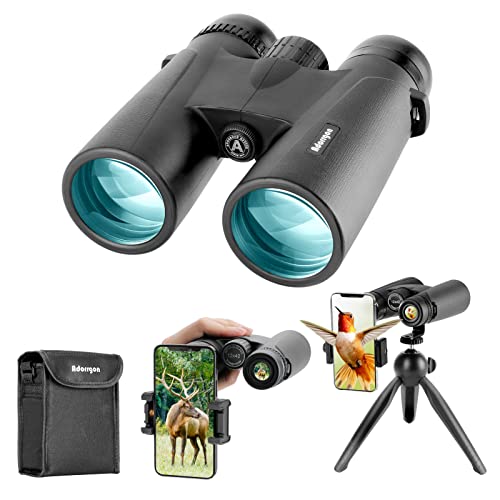
Adorrgon 12×42 with phone adapter and tripod
Product details
Adorrgon 12×42 with adapter and tripod
An offer was available on November 4, 2026. Confirm the exact model, included components and current availability.
The Adorrgon combines 12×42 optics with a phone adapter and compact tripod. Its calculated exit pupil is 3.5 mm. The current listing describes fully multi-coated optics, a center focus wheel and right-eye diopter adjustment.
Consider it when a supported view and occasional phone capture are important, but check adapter fit against your phone and camera placement. The earlier claim that it fits every phone with every case was too broad. An included small tripod is an accessory, not proof of built-in image stabilization or guaranteed shake-free photographs.
Listings without confirmed immediate availability
These original destinations remain for reference. Two were out of stock; two returned an availability-date status rather than an in-stock confirmation. None is presented as a confirmed immediately available purchase.
Vortex Triumph HD 10×42

Product details
Vortex Triumph HD 10×42 — availability unconfirmed
The API returned an availability-date status on November 4, 2026 without a confirmed immediate date. Confirm stock and delivery timing.
The listing identifies the Triumph as 10×42 with fully multi-coated lenses, a polycarbonate chassis, nitrogen purging and a GlassPak harness. One returned feature line says “1x,” conflicting with the 10×42 model title; do not treat that apparent typo as a different magnification.
An availability-date status was returned, but no usable delivery date was supplied. Confirm current stock and timing before relying on this option for an upcoming trip. The original article’s generic claims about higher cost or poor eyeglass suitability were not supported by a direct comparison.
Vortex Bantam HD 6.5×32 youth binoculars

Product details
Vortex Bantam HD 6.5×32 — availability unconfirmed
The API returned an availability-date status on November 4, 2026 without a confirmed immediate date. Confirm stock and delivery timing.
The Bantam is a lower-powered 6.5×32 design intended for younger users, with adjustable controls, XR lens coatings and tripod adaptability. Its nominal exit pupil is about 4.92 mm. Lower power can make image movement easier to manage, but fit must still be checked.
This listing also returned an availability-date status without a confirmed immediate date. “Youth” does not prove it cannot fit any adult, just as a small body does not guarantee it fits every child. Check the hinge adjustment and viewing comfort rather than using age alone.
Bushnell Trophy 10×42, Realtree Xtra

Product details
Bushnell Trophy 10×42 — Realtree Xtra
Unavailable on November 4, 2026. Original destination retained for reference.
The exact Trophy variant was out of stock. Its listing describes fully multi-coated lenses, BAK-4 prisms, waterproof and fogproof construction, and two-step twist-up eyecups. The original article contradicted itself by describing it as both lightweight and heavy, while giving unsupported blanket judgments about low-light performance. Those judgments are not retained.
usogood 12×42 with adapter and tripod

Product details
Unavailable on November 4, 2026. Original destination retained for reference.
The usogood listing was out of stock. It describes a phone adapter, adjustable tripod, center focus wheel and right-eye diopter. Its accessory tripod should not be confused with optical or electronic image stabilization, even though the seller’s text uses stabilization language. Verify phone fit and package contents if an offer returns.
How to make the final choice
Start with 8×42 if you mainly scan while standing, often lose subjects in the view or prefer easier eye placement. Start with 10×42 if distant detail is a recurring need and you can keep the view steady. Compare equivalent quality levels and check the actual field of view; the model design can matter as much as the 8× or 10× label.
Before ordering, confirm eye fit, sealing, accessory compatibility, return terms and the exact variant. Before the trip, practice focus and diopter setup using the manual. Keep lens covers in place during transport and use the manufacturer’s cleaning method rather than rubbing grit across the glass.
Frequently asked questions
Does 10×42 see farther than 8×42?
It gives greater apparent magnification, but there is no universal usable-distance cutoff for either. Light, atmospheric conditions, contrast, optical quality and image steadiness affect what you can identify.
Are 8×42 binoculars always brighter?
They have a larger calculated exit pupil than 10×42. That does not guarantee a brighter or more detailed view across different models and conditions. Compare similar-quality optics and consider your own viewing comfort.
Does a tripod make 12× binoculars equivalent to 8×?
No. Support reduces movement, but it does not change magnification, exit pupil, field of view or eye relief. Those remain properties of the binocular design.
Do these binoculars measure distance?
No rangefinding function was verified for the linked models. Magnification and a field-of-view specification are not distance measurements. Do not assume “hunting binoculars” means a built-in laser rangefinder.